


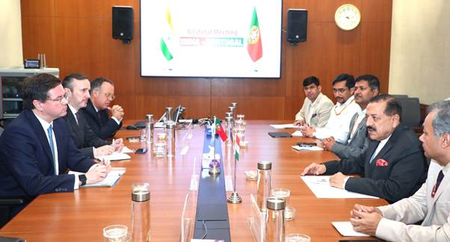
India and Portugal have agreed to establish a joint working mechanism focusing on administrative reforms and digital governance, emphasizing the use of artificial intelligence in public services. This decision was reached during discussions between Dr. Jitendra Singh, India’s Minister of State for Science and Technology, and Goncalo Matias, Portugal’s Minister of State Reform, at the AI Impact Summit 2026 in New Delhi. Dr. Singh proposed the formation of a working group to identify key areas for cooperation, such as digital pension systems and AI-enabled document processing.
Dr. Singh highlighted India’s significant reform efforts over the past decade, including the elimination of outdated rules that hindered citizen services. He mentioned the removal of colonial-era requirements like mandatory attestation by gazetted officers and interview-based recruitment for certain categories. India’s grievance redressal mechanism, operating on a hybrid model combining AI and human oversight, has achieved a nearly 95% disposal rate, with final decisions still involving human intervention.
Portugal, on the other hand, is focusing on simplification and digitalization in its reform agenda. Matias shared that Portugal is revising core codes related to public procurement and licensing before integrating AI into administrative decision-making processes. The country aims to use AI to expedite document processing while ensuring human validation of final decisions. Additionally, Portugal is investing in AI adoption by small and medium enterprises, particularly those affected by recent climate events.
Both countries also discussed enhancing cooperation in trade, technology, and education, in addition to expediting their consultative body meeting under the existing MoU on public administration and governance reforms. The meeting reflects a deeper engagement between India and Portugal, moving towards practical alignment in administrative simplification and AI-led governance, beyond traditional ceremonial interactions.
