


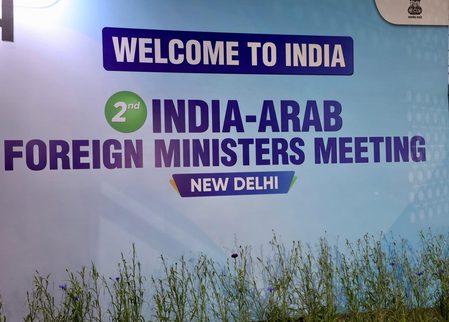
India is set to host the 2nd India-Arab Foreign Ministers’ Meeting (IAFMM) in New Delhi on Saturday, strengthening ties with the Arab world. Co-chaired by India and the United Arab Emirates (UAE), the high-level meeting will include foreign ministers and senior representatives from all 22 member states of the Arab League, along with the Arab League Secretary General.
The Ministry of External Affairs (MEA) revealed that this meeting, after nearly a decade, follows the first India-Arab Foreign Ministers’ Meeting held in Bahrain in 2016. The MEA stated that the 2nd India-Arab FMM aims to enhance existing cooperation and deepen the partnership between India and the Arab League.
The India-Arab Foreign Ministers’ Meeting serves as the primary institutional mechanism for cooperation between India and the League of Arab States (LAS). Established in March 2002 with a Memorandum of Understanding, this dialogue framework was further strengthened in 2013 to enhance its organizational structure. India currently holds observer status in the Arab League.
The first Foreign Ministers’ Meeting in 2016 identified five key areas of cooperation: economy, energy, education, media, and culture. The upcoming meeting will review progress in these sectors and explore opportunities for increased collaboration, reflecting the growing political, economic, and strategic engagement between India and Arab countries.
This marks the first time India is hosting the India-Arab Foreign Ministers’ Meeting in New Delhi, highlighting the significance of India’s partnership with the Arab world. The MEA emphasized that the meeting will witness participation from all 22 Arab countries, including Foreign Ministers, other Ministers, Ministers of State, and Senior Officials from the Arab League.
Ahead of the ministerial-level talks, the 4th India-Arab Senior Officials’ Meeting on January 30 laid the groundwork for in-depth discussions and coordination. Diplomatic observers view this meeting as a crucial platform to invigorate India-Arab relations amidst evolving regional and global challenges, with a focus on economic cooperation, energy security, and people-to-people ties.
