


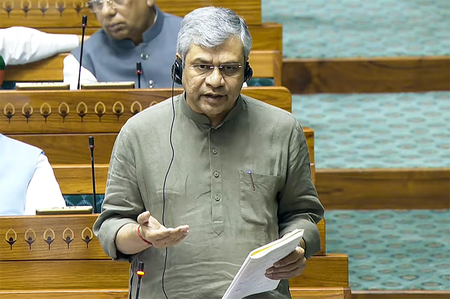
The Railways Minister informed Parliament that the number of train accidents on Indian Railways has significantly decreased over the years, with consequential accidents dropping by almost 90%. Safety remains a top priority for Indian Railways, leading to a substantial improvement in operational safety.
From 135 accidents in 2014-15, the number of consequential train accidents has reduced to just 14 in 2025-26 (as of February 28). Data presented by the minister indicated a decline in accidents from 1,711 during 2004-05 to 2013-14 to 678 between 2014-15 and 2023-24, with a decrease in deaths and injuries as well.
The minister attributed the decrease in accidents to various safety initiatives such as enhanced track maintenance, modern signaling systems, and technological upgrades. Expenditure on safety-related activities has notably increased, reaching Rs 1,17,693 crore in 2025-26, with a further allocation of Rs 1,20,389 crore for 2026-27 to continue improving safety measures.
To reduce human error, electronic interlocking systems have been installed at 6,665 stations, and interlocking has been provided at over 10,153 level crossing gates. Additionally, complete track circuiting has been implemented at 6,669 stations, contributing to enhanced safety measures on Indian Railways.
The rollout of ‘Kavach,’ an automatic train protection (ATP) system developed domestically, has been adopted as a national system since 2020. The latest version of Kavach has been deployed across 1,452 route kilometers, covering significant high-density corridors like Delhi-Mumbai and Delhi-Howrah routes, further ensuring safety.
Continuous investments in technology and infrastructure are playing a crucial role in enhancing safety and reducing accidents on Indian Railways, as highlighted by the Railways Minister.
