


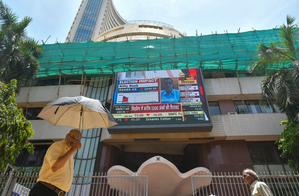
The Indian stock market faced slight losses early on Wednesday due to escalating geopolitical tensions and fresh tariff worries, following a mix of signals from Asian markets. The Sensex dropped by 156 points, or 0.18%, to 84,907, while the Nifty decreased by 54 points, or 0.21%, to 26,124 by 9:30 am. Notably, the Nifty Midcap 100 rose by 0.22%, and the Nifty Smallcap 100 gained 0.25%, showing a divergence from the main indices.
In sectoral terms, Nifty Auto experienced the most significant decline at 0.49%. Conversely, sectors like consumer durables, IT, and metal saw gains of 1.15%, 0.91%, and 0.53%, respectively. Market analysts highlighted immediate support levels at 26,000–26,050 and resistance levels at 26,300–26,350. They noted a lack of clear market trends recently, with a few major stocks disproportionately influencing the market, leading to a 71-point drop in the Nifty despite positive institutional buying.
Market experts pointed out that recent market movements lacked a clear trend, with specific mega stocks significantly impacting the market. The fall in the Nifty by 71 points was attributed to sharp declines in two stocks, reflecting technical rather than fundamental factors. The large derivative and cash market volumes of these two stocks indicated settlement day activities, according to analysts. They also highlighted the potential for high volatility in the market due to events such as US President Donald Trump’s actions or tweets and the US Supreme Court’s decision on Trump’s tariffs.
In the Asian region, defense stocks’ two-day winning streak was interrupted, with investors assessing geopolitical risks following the US attack on Venezuela and renewed tensions over Greenland. Market movements in Asian markets varied, with China’s Shanghai index and Shenzhen gaining, Japan’s Nikkei and Hong Kong’s Hang Seng Index declining, and South Korea’s Kospi advancing. Meanwhile, the US markets closed positively, with Nasdaq, S&P 500, and Dow Jones posting gains.
Foreign institutional investors (FIIs) sold net equities worth Rs 106 crore on January 6, while domestic institutional investors (DIIs) bought equities worth Rs 1,749 crore, indicating mixed investor sentiment.
