


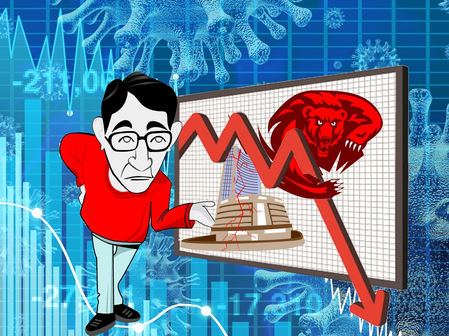
Indian benchmark indices experienced significant selling pressure on Thursday, marking their most substantial drop in over two weeks. The Sensex concluded at 82,498.14, down by 1,236.11 points or 1.48%, while the Nifty settled at 25,454.35, a decrease of 365 points or 1.41%. This decline represented the steepest single-day fall since February 1 this year.
Experts noted that the price action fell below the short-term support band of 25,645–25,660, aligning with the 20-day EMA. Consequently, selling pressure intensified moderately, driving the index towards the 25,350–25,400 support area and breaching previous short-term demand levels. The market downturn was primarily influenced by surging crude oil prices and escalating tensions between the United States and Iran, heightening global uncertainty.
The market saw profit-taking in heavyweight stocks from the banking and FMCG sectors, further contributing to the downward trend. All 30 stocks in the Sensex closed in the negative territory, with IndiGo, M&M, UltraTech Cement, Trent, and BEL among the top losers, recording declines of up to 3.2% during the session. The broader markets also faced pressure, with the Nifty Midcap 100 index dropping by 1.59% and the Nifty Smallcap 100 index falling by 1.27%.
Sector-wise, Nifty Realty, Nifty Media, and Nifty Auto were the worst performers, each witnessing around a 2% decline. Additionally, the Nifty FMCG, private, and public sector bank indices also registered drops exceeding 1%. Foreign portfolio investors continued reducing their exposure to Indian equities, particularly selling information technology stocks worth Rs 10,956 crore in the first half of February.
Despite an overall inflow of Rs 29,709 crore into Dalal Street during the same period, IT stocks faced significant selling pressure. Market analysts anticipate cautious investor sentiment in the short term due to global uncertainties and the volatility in crude oil prices. Gold prices traded positively following unsuccessful US-Iran talks, reigniting military tensions and prompting fresh safe-haven buying.
