


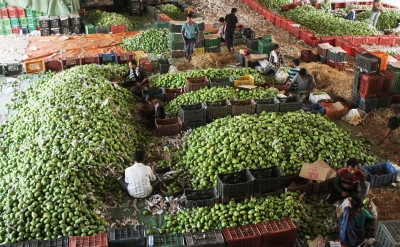
In a significant development for India’s fresh produce export industry, the Agricultural and Processed Food Products Export Development Authority (APEDA) has overseen the maiden commercial sea transport of premium Banganapalle mangoes from India to Singapore. The shipment, totaling 5 metric tonnes, was sent by Osum Food Solutions on June 11 and reached Singapore on June 24, marking a milestone in enhancing export logistics for Indian horticultural products. The ICAR–Central Institute for Subtropical Horticulture (CISH), Lucknow, played a crucial role in ensuring the success of this endeavor.
The Banganapalle mangoes were sourced from Good Agricultural Practices (GAP)-certified orchards in Andhra Pradesh, processed, and packed at an APEDA-recognized packhouse in Karnataka. The entire process adhered to Singapore’s quality and phytosanitary standards. Upon inspection in Singapore, the importer, EC-Links Pte Ltd, praised the mangoes for their exceptional quality, sweetness, uniform ripening, shelf life, and overall phytosanitary condition.
The successful shipment met all import criteria, showcasing the efficiency of post-harvest management practices and cold-chain logistics in sea transportation. This export venture brought significant economic gains for farmers, with the export price nearly doubling the local market rates, thereby enhancing the income of growers. The utilization of sea freight for fresh fruit transport is gaining momentum due to its cost-effectiveness, environmental sustainability, and scalability, supported by a robust cold-chain infrastructure and efficient logistics management.
Banganapalle mangoes, renowned for their golden-yellow hue, delightful fragrance, fiberless pulp, and rich sweetness, are in high demand globally, presenting a substantial opportunity for expanding India’s mango exports. APEDA’s advocacy for sea freight in fresh produce exports, along with efforts in market development and infrastructure support, is expected to encourage more exporters to adopt maritime transport, bolstering India’s standing as a reliable source of high-quality agricultural products in the global market. This initiative aligns with the Indian government’s broader agenda of boosting agricultural exports, uplifting farmers’ incomes, and enhancing the global presence of Indian agricultural produce through sustainable export channels.
