


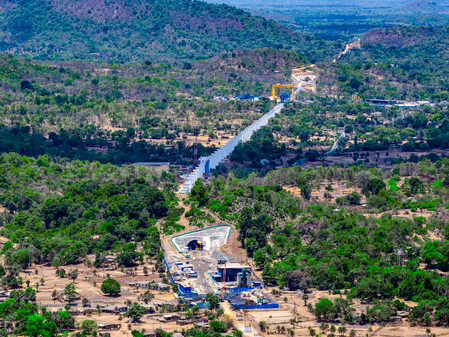
The Mumbai–Ahmedabad High-Speed Rail (MAHSR) Project is a groundbreaking development in India’s railway sector, setting new benchmarks in speed, connectivity, and infrastructure. Progress in civil works, bridge construction, and tunnelling indicates a steady pace towards project completion. Advanced technologies and engineering practices are being embraced to enhance domestic capabilities in high-speed rail development.
The high-speed rail service on this corridor is scheduled to begin in August 2027, significantly reducing travel time between Mumbai and Ahmedabad to under two hours. This journey, which currently takes 8-9 hours by road and 4-5 hours by air, including airport procedures, will be transformed. The MAHSR Project boasts a design speed of 350 kmph and an operational speed of 320 kmph, surpassing existing rail speeds in India.
Connecting Mumbai and Ahmedabad in about 1 hour 58 minutes, the MAHSR Project is a massive infrastructure endeavor that not only enhances transportation but also fuels India’s aspirations for long-term high-speed rail networks. It will establish a comprehensive high-speed rail ecosystem, encompassing various construction aspects like viaducts, ballastless tracks, tunnels, bridges, and stations, along with signaling and power systems.
The MAHSR corridor, spanning 508 kilometers and passing through Maharashtra, Gujarat, and Dadra & Nagar Haveli, features 12 stations designed to reflect the unique essence of each city. Sabarmati station, a key hub, integrates various transport modes like the bullet train, metro, BRTS, and railways. The project, developed with Japanese Shinkansen technology, emphasizes efficient construction, operational excellence, and urban integration, with noise barriers to minimize operational noise.
