


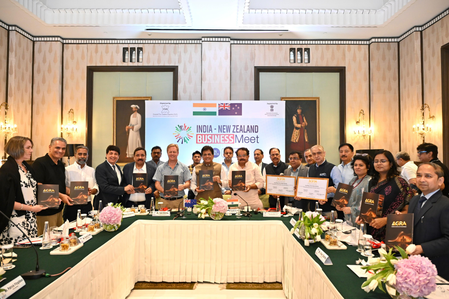
India’s Ministry of Commerce and Industry has highlighted the potential for significant growth in the country’s leather industry, aiming to reach $50 billion by 2030. The upcoming Free Trade Agreement (FTA) with New Zealand is expected to play a crucial role in this expansion, emphasizing a shift towards high-value-added manufacturing. Union Minister for Commerce and Industry Piyush Goyal and New Zealand’s counterpart Todd McClay engaged in an Industry Engagement Programme in Agra ahead of the FTA signing.
The collaboration between New Zealand’s raw leather resources and India’s manufacturing capabilities is seen as mutually beneficial, with both countries expressing a strong interest in leveraging this partnership. Agra, known for producing 75% of India’s leather footwear and holding a Geographical Indication (GI) tag for its products, is poised to become a global sourcing hub and an export powerhouse. The FTA is set to eliminate duties on all Indian exports upon implementation, providing Indian exporters with a competitive edge.
The FTA between India and New Zealand is not just about tariffs but encompasses various aspects such as market access, investment, and talent mobility. It aims to benefit a wide range of stakeholders, including manufacturers, farmers, MSMEs, women entrepreneurs, students, and skilled professionals in both nations. The agreement also focuses on sectors like pharmaceuticals and medical devices, introducing provisions for faster regulatory access and including a dedicated chapter on Health and Traditional Medicine.
