


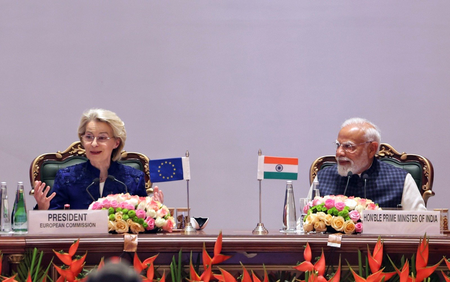
India’s ties with Germany and the European Union (EU) have evolved into a strategic partnership encompassing economics, technology, and mutual interests in a stable Indo-Pacific region. Recent high-level visits and enhanced frameworks with key European nations and the EU have solidified Europe as India’s second strategic focus after the Indo-Pacific’s core Quad network. This shift signifies a move from trade-centric relations to a strategic collaboration involving technology supply chains, defense co-production, clean energy transition, and joint Indo-Pacific initiatives.
The European Union, particularly Brussels, now views India as a systemic stabilizer and a significant voice representing the “Global South.” Notable developments include the EU College of Commissioners’ unprecedented visit to India in February 2025, highlighting the growing strategic importance of the relationship. Individual European nations have also intensified their engagements with India. France has upgraded its ties to a “Special Global Strategic Partnership,” while Germany commemorates 25 years of a Strategic Partnership. Italy has introduced a detailed Joint Strategic Action Plan for 2025-2029, and Finland has strengthened its strategic partnership through high-level engagements.
This strategic alignment between India and Europe involves a multi-layered approach, combining EU-level frameworks on trade, digitalization, and connectivity with state-level cooperation in defense, industry, and technology. These collaborations directly contribute to India’s growth and security objectives, fostering a comprehensive partnership that spans various sectors. Germany, historically tied to India through economic relations, has now shifted its focus towards a strategic industrial and green transition partnership. Chancellor Friedrich Merz’s visit to India in January 2026 emphasized Berlin’s recognition of New Delhi as a primary partner in the Indo-Pacific region, signaling a departure from viewing India as a peripheral market.
India leverages German capital and technology to mitigate risks associated with its supply chains exposed to China and to accelerate domestic manufacturing and green energy initiatives. On the other hand, Germany sees India as a valuable market for diversification away from Chinese dependencies, while also viewing India as a politically acceptable partner in the Indo-Pacific region, aligning with Berlin’s evolving regional strategy.
