


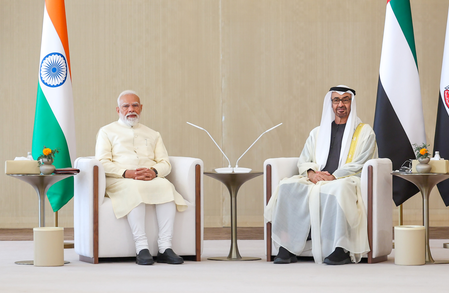
India’s traditional nonalignment strategic autonomy is evolving into proactive engagement and power projection for a competitive multipolar era, as per a recent report. The Defence Force vision 2047 document by the Defence Ministry indicates a recentering of force in Indian foreign policy, emphasizing that strategic autonomy is transitioning from defensive to proactive and power projective strategies. Prime Minister Modi’s evolving Middle East policy reflects this change, focusing on strategic projection and security partnerships rather than just energy security and remittances.
India and the UAE recently inked a strategic defence partnership aiming to enhance defence industrial collaboration. This partnership goes beyond bilateral ties and aligns with the broader strategic framework of I2U2, connecting India, the UAE, Israel, and the US through technology, connectivity, and logistics cooperation. While not a military pact, I2U2 demonstrates a minilateral architecture integrating economic integration with strategic coordination.
The strategic petroleum reserves play a crucial role in the India-UAE partnership, allowing India to store its oil reserves in the UAE’s Fujairah. This move not only fosters energy interdependency but also enhances India’s stake in safeguarding infrastructure and maritime routes. With the Defence Vision 2047 emphasizing the need to address emerging conflicts, New Delhi’s protection of these reserves, routes, and infrastructure becomes paramount.
Described as a “flexible alliance without treaty obligations,” the partnership between India and the UAE signifies the evolution of strategic autonomy. In contrast to the Pakistan-Saudi Arabia defence agreement, the India-UAE deal does not include a mutual defense clause. This partnership showcases India’s commitment to maintaining strategic autonomy while actively participating in the Middle East’s security architecture.
