


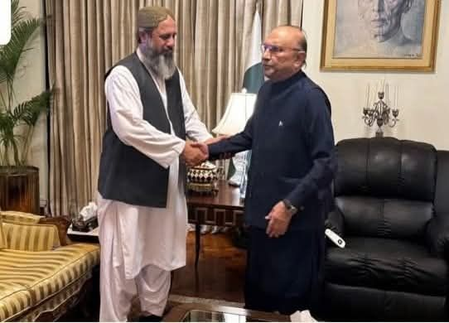
An Islamic State Commander named Shafiq Mengal has recently met with Pakistan President Asif Ali Zardari and has officially joined the Pakistan Peoples Party (PPP). This move is significant as the Islamic State has been enlisted by the Pakistan establishment to combat the Balochistan Liberation Army (BLA). Mengal, a tribal leader known for leading death squads against the Baloch people, will now be involved in coordinating various terror groups in Balochistan, including Lashkar-e-Tayiba and Jaish-e-Mohammad, to work alongside the Islamic State under his leadership.
Indian agencies closely monitoring these developments have highlighted that Mengal’s affiliation with the PPP is not merely a routine political event but a strategic maneuver by the establishment to provide him with political cover for undertaking covert operations on behalf of the army and ISI. Mengal’s primary task will be to unite terror groups in Balochistan to combat the BLA, with direct supervision from the heads of the ISI and Military Intelligence.
The Pakistan security forces are facing challenges in suppressing the BLA, which enjoys public support, making it difficult for the authorities to contain the group. Mengal’s role will involve coordinating an attack on the BLA with the aim of dismantling the group, as the BLA’s activities have posed obstacles to security guarantees provided by Pakistan to countries like the US and China.
Pakistan’s engagement in the China-Pakistan Economic Corridor project with China has been impacted by BLA attacks, leading to significant losses for the Chinese in terms of investments and manpower. Similarly, Pakistan’s mineral deal with the US, focusing on Balochistan’s resources, has faced opposition from the BLA, which argues that such agreements do not benefit the Baloch people but rather serve the interests of the elite in mainland Pakistan.
Mengal has already initiated plans to relocate Islamic State operatives from Afghanistan to Balochistan, setting up safe houses and training facilities for them. This strategic move is expected to reduce the security forces’ direct involvement in combating groups like the BLA, as Mengal’s unified command structure takes charge of operations. The integration of an Islamic State terrorist into the PPP, which governs Balochistan as part of a coalition, has raised concerns among observers, who view this as a dangerous trend of mainstreaming terrorists and granting them political power.
Experts caution that if successful in Balochistan, this model could be replicated in other regions like Khyber Pakthunkwa (KP), where security forces are struggling against groups such as the Tehreek-e-Taliban Pakistan (TTP) and others. Pakistan’s history of nurturing terrorists and granting them political influence is seen as a worrying trend that could have broader implications beyond Balochistan.
