


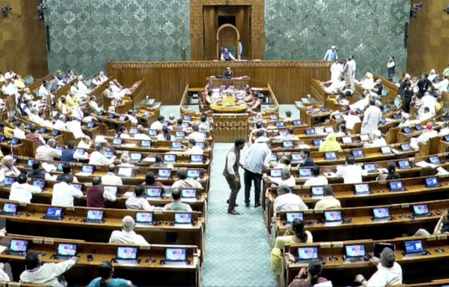
The Lok Sabha approved the Constitution (One Hundred and Thirty-First Amendment) Bill, 2026, to enable women’s reservation and delimitation after a division of votes. Union Law Minister Arjun Meghwal presented the Bill in a significant legislative move, following earlier support from Members of Parliament for its discussion.
The Bill, along with the Delimitation Bill 2026 and Union Territories Laws (Amendment) Bill 2026, was introduced in the Lok Sabha. The introduction of the Constitution (One Hundred and Thirty-First Amendment) Bill, 2026, came after a division was demanded by the Opposition and subsequently supported by the House.
During the voting process, 251 members were in favor and 185 against the Bill, subject to change as announced by Speaker Om Birla. The Lok Sabha usually uses voice voting, but in contested outcomes, a division is conducted using the Automatic Vote Recorder system to register votes under different categories.
Following the division, 333 members cast their votes without any abstentions using vote slips. The Opposition’s call for a division was in relation to the Women’s Reservation Bill, which required a simple majority for approval, leading to heightened political engagement during the voting process.
Lok Sabha Secretary General Utpal Singh explained the automatic vote recording system to members, emphasizing the norm of voice votes and the invocation of a division upon members’ demand. Members were informed about the voting procedures and the option to change their votes if needed.
