


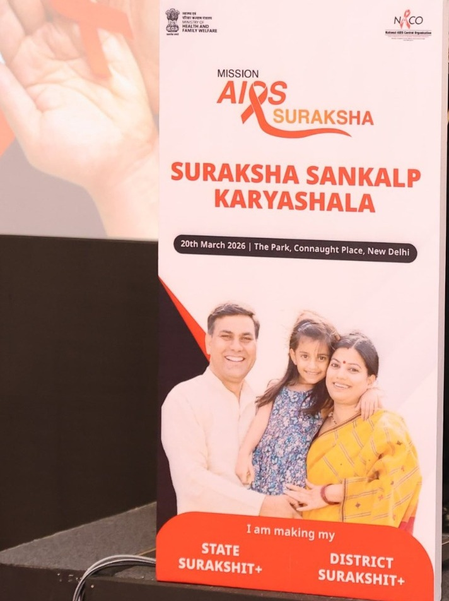
The Ministry of Health and Family Welfare held the ‘Suraksha Sankalp Karyashala’ in New Delhi to enhance the district-level HIV/AIDS response, with a focus on Haryana and Delhi. This workshop, facilitated by the National AIDS Control Organisation, aimed to bring together district program teams to discuss progress, address operational challenges, and devise action plans to bolster the HIV response at the grassroots level. The initiative aims to foster collaborative planning among national, state, and district stakeholders to improve treatment linkage and retention, enhance viral load suppression among HIV-positive individuals, and expand outreach to vulnerable populations.
Deliberations during the workshop emphasized the need to strengthen program implementation through enhanced inter-sectoral coordination, capacity building, and robust monitoring mechanisms. The focus was on aspects such as early diagnosis, timely treatment initiation, sustained adherence to Anti-Retroviral Therapy (ART), and the eradication of stigma and discrimination. Rakesh Gupta, Additional Secretary and Director General of NACO, elaborated on the ’95:95:95 targets’ endorsed globally, aiming for 95% of people living with HIV to be aware of their status, 95% of diagnosed individuals to be on sustained ART, and 95% of those on treatment to achieve viral suppression.
Haryana has made significant progress, achieving a ratio of around 81:83:95, indicating the need for intensified efforts to enhance diagnosis and treatment linkage. In contrast, Delhi faces challenges, with only about 70% of identified individuals currently linked to or receiving treatment, underscoring the urgency to improve treatment coverage and retention. Gupta highlighted that AIDS remains a substantial public health concern, requiring continuous vigilance, innovation, and coordinated efforts across all levels of governance.
The ministry highlighted that 219 districts, including 11 in Haryana and seven in Delhi, have been identified as priority areas for intensified interventions. Delhi has an adult HIV prevalence of 0.33%, with an estimated 59,079 people living with HIV, while Haryana’s adult HIV prevalence stands at 0.24%, with an estimated 59,642 individuals living with HIV.
