


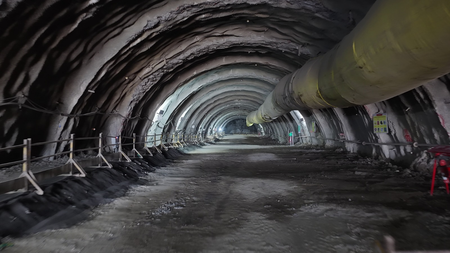
The Mumbai-Ahmedabad Bullet Train project has made significant progress by successfully breaking through its third mountain tunnel in Maharashtra. The tunnel, known as MT-07, located in Ambesari village in Palghar district, is 417 meters long and 14.4 meters wide, designed to accommodate both up and down tracks of the high-speed rail corridor. The breakthrough was accomplished using controlled drilling and blasting methods, ensuring structural stability and safety with advanced monitoring systems and geotechnical instruments.
The National High Speed Rail Corporation Limited (NHSRCL) reported that the breakthrough at Ambesari village signifies rapid advancement in one of the most challenging sections of India’s first high-speed rail corridor. The excavation of the tunnel involved meticulous planning and execution, with real-time monitoring arrangements in place to track vibrations, tunnel behavior, and the impact of excavation on nearby structures. Safety measures for workers included ventilation systems, fire protection arrangements, controlled access, and continuous geotechnical monitoring inside the tunnel.
This achievement follows the completion of two other mountain tunnels in the same section within the last five months. With MT-08, MT-07, and MT-06 now fully excavated, the project is progressing steadily. The Mumbai-Ahmedabad High-Speed Rail corridor, utilizing Japanese Shinkansen technology, will span 508 km, connecting Mumbai and Ahmedabad through 12 stations across Maharashtra, Gujarat, and the Union Territory of Dadra and Nagar Haveli and Daman and Diu.
Construction is ongoing on various sections of the route, including viaducts, river bridges, stations, and a 21-km underground and undersea tunnel segment in Maharashtra. Once operational, the bullet train service is expected to significantly reduce travel time between Mumbai and Ahmedabad to just over two hours, enhancing connectivity and transportation efficiency in the region.
