


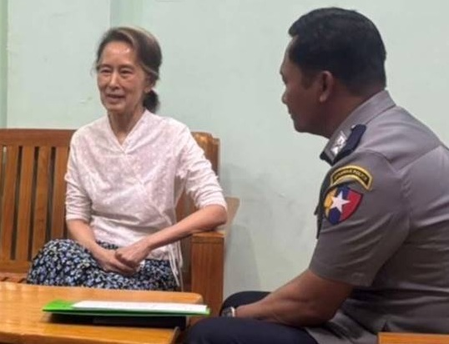
Myanmar’s leader, Aung San Suu Kyi, has been shifted from prison to house arrest, aiming to present a facade of democracy in the country ruled by the military junta. The decision to transfer her to house arrest was announced by Myanmar’s Ministry of Information, stating that it was to commute her remaining prison sentence. Aung San Suu Kyi, who previously served as the state counsellor and de facto leader of the civilian government, was ousted by the military in a coup last year.
The military leader, Min Aung Hlaing, who orchestrated the coup, has now been elected as the president of Myanmar by the parliament. The recent election, which excluded Aung San Suu Kyi’s National League for Democracy, took place amidst international efforts to legitimize the ruling regime. Aung Hlaing has also pledged amnesties to foster social reconciliation in the country.
Following the election, Aung Hlaing’s administration released over 4,300 political prisoners, including the former president, Win Myint, who was detained after the coup. The National Unity Government, representing the ousted civilian leaders, expressed satisfaction with the release of political prisoners. Aung San Suu Kyi, aged 80 and in poor health, was moved to house detention as a gesture of goodwill by the state, coinciding with a significant Buddhist festival in Myanmar.
The decision to reduce Aung San Suu Kyi’s sentence, initially totaling 33 years, was announced by the junta, citing reasons of benevolence. Despite the reduction in her sentence to 22 years and six months, she will remain under house arrest. Aung San Suu Kyi, a graduate of Lady Shri Ram College in Delhi, is the daughter of Aung San, a prominent figure in Myanmar’s independence movement.
