


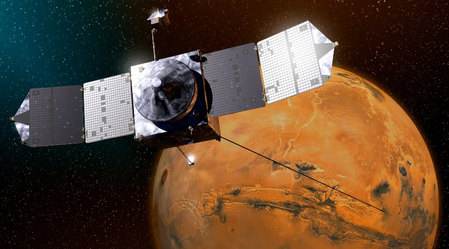
The Mars Atmosphere and Volatile Evolution (MAVEN), NASA’s inaugural mission dedicated to studying the Martian atmosphere and its changes, has concluded after losing contact with its spacecraft in December. Launched on November 18, 2013, MAVEN entered Mars’ orbit on September 21, 2014, surpassing its planned one-year primary mission to operate for over 11 years.
The spacecraft’s last signal was received on December 6, 2025, following an unexpected loss of communication as it passed behind Mars. Despite efforts to recover the spacecraft’s signal, NASA’s anomaly review board confirmed MAVEN as irrecoverable, rendering it incapable of fulfilling its scientific and data relay tasks.
Preliminary investigations indicate that MAVEN entered a rapid rotation after passing behind Mars, disrupting its orbit and depleting its power supply, leading to a loss of contact with Earth. NASA continues to investigate the root cause of this anomaly, with a final report expected later this year.
NASA has initiated the formal decommissioning process for the MAVEN mission, adhering to standard protocols to preserve the complete mission dataset for scientific and exploration purposes. Louise Prockter, director of NASA’s Planetary Science Division, emphasized the significance of MAVEN’s scientific contributions in shaping future radiation protection measures for human missions to Mars.
