


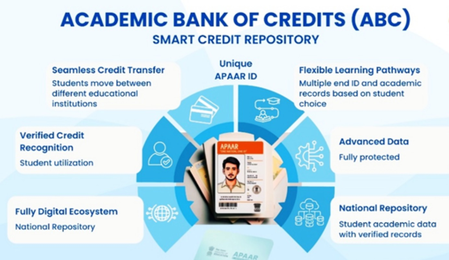
Students in India can now use a 12-digit student identification number called Automated Permanent Academic Account Registry (APAAR) to digitize their achievements, simplify credit transfers between institutions, and enhance transparency in academic record-keeping. This system, linked to the Academic Bank of Credits (ABC), aims to create a seamless education ecosystem by integrating schools, universities, skill institutions, and other stakeholders. ABC, managed by the Ministry of Education and regulated by the University Grants Commission (UGC), offers a digital platform for storing, managing, transferring, and redeeming academic credits earned by students from recognized educational institutions.
The initiative aligns with the National Education Policy (NEP), 2020, and the National Credit Framework (NCrF) by enabling credit transfer, multiple entry and exit options, and the recognition of learning across various institutions and disciplines. APAAR’s objective is to establish ‘One Nation, One Student ID,’ requiring all college or university-going students to register on ABC to create a unified academic identity. Accessible through DigiLocker, APAAR consolidates a student’s educational records from different programs onto a single platform, with IDs generated through Common Service Centres (CSC) even in remote areas.
As of June 2026, over 26.3 crore verified APAAR IDs have been issued nationwide, facilitating the seamless accumulation and redemption of credits across multiple Higher Education Institutions (HEIs). The integration of ABC with the National Academic Depository (NAD)-DigiLocker ensures secure access to verified academic records for students. Furthermore, the initiative has bridged the digital gap by enabling on-ground registration through Common Service Centres in remote villages, fostering a trusted digital ecosystem for academic records.
ABC and APAAR are instrumental in building a flexible, transparent, and accessible education system that promotes lifelong learning and secure record management. These initiatives, along with emerging technologies like the Bharat Praman Chain, are enhancing the security and authenticity of digital academic credentials, aligning with the principles of NEP 2020 and contributing to India’s digital governance and socio-economic development efforts.
