


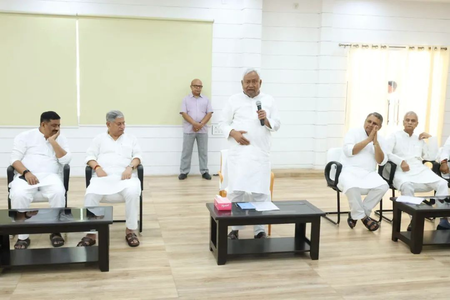
Nitish Kumar, having resigned as Bihar’s Chief Minister and shifted to the Rajya Sabha, is now concentrating on enhancing the Janata Dal-United’s (JD-U) organizational setup. In a significant move to revitalize the party, JD-U has introduced a new national team consisting of 24 leaders.
Nitish Kumar will lead as the party’s President, with Sanjay Kumar Jha appointed as the National Working President. Chandeshwar Chandravanshi, a former MP from Jehanabad, has been designated as the JD-U Vice President, and Alok Kumar Suman will assume the role of the party’s Treasurer.
The list of General Secretaries includes notable figures like Manish Kumar Verma, Afaq Ahmed Khan, Shyam Rajak, Ashok Choudhary, Ramesh Singh Kushwaha, Ram Sevak Singh, Kahkashan Perween, Kapil Harishchandra Patil, Raj Singh, Sunil Kumar, Harshvardhan Singh, and Ghulam Rasool Balyavi.
Leaders such as Rajiv Ranjan Prasad, Ravindra Prasad Singh, Vidya Sagar Nishad, Dayanand Rai, Sanjay Kumar, Mohammad Nisar, Ruhi Tagung, and Nivedita Kumari have been appointed as Secretaries. This restructuring follows a Legislative Party meeting on April 20, where Nitish Kumar was granted full authority to make crucial decisions in the party’s favor.
He also named Shravan Kumar as the JD-U Legislative Party leader in the Bihar Assembly. These changes underscore Nitish Kumar’s renewed commitment to fortifying the party structure and readying JD-U for upcoming political tests. Nishant Kumar, Nitish Kumar’s son, is gearing up to kick off a statewide yatra across Bihar starting May 3.
This initiative is seen as a significant move to establish his presence in active politics, aiming to engage directly with people throughout the state and rally grassroots support for the JD-U. The yatra is anticipated to span multiple districts, emphasizing public engagement and strengthening the party’s grassroots network.
Moreover, Nishant Kumar’s yatra is perceived as an effort to assert his political significance, both among the populace and within the party hierarchy. While he has mostly remained aloof from active politics, this endeavor hints at a potential shift towards a more visible and participatory role in Bihar’s political domain.
