


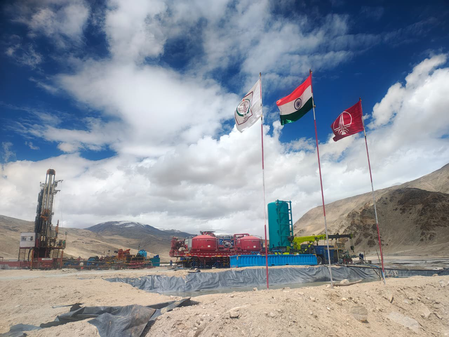
Public sector Oil and Natural Gas Corporation (ONGC) has finished drilling its second geothermal well in Ladakh’s Puga Valley, marking a significant milestone in India’s inaugural geothermal power plant development. ONGC Energy Centre, the company’s research and development division, successfully drilled the well to a depth of 1,000 meters at an altitude exceeding 14,000 feet within a month, surpassing the time and cost of its initial geothermal drilling endeavor. This latest achievement follows the triumph of ONGC’s first geothermal well in Puga, which generated steam surpassing water’s boiling point, showcasing the region’s geothermal potential.
The completion of the second well is a crucial step towards establishing India’s first 1-megawatt electric (MWe) pilot geothermal power plant and could open doors for the commercial utilization of geothermal energy in the nation. Future plans for the project involve setting up a 1 MWe pilot geothermal power plant and the sustainable exploitation of geothermal resources to ensure consistent baseload electricity supply for Ladakh. The Puga geothermal field, situated in eastern Ladakh, stands out as India’s most promising geothermal asset.
Geothermal energy, which taps into subterranean heat to generate electricity and heating, offers a continuous, eco-friendly power source. Unlike solar and wind energy, which rely on weather conditions, geothermal energy is deemed a stable and reliable energy alternative. Despite intermittent exploratory efforts over the years, commercial geothermal power generation in the Puga geothermal field has faced technical and economic hurdles hindering a breakthrough.
India remains on course to achieve its 2030 target of 500 GW non-fossil fuel energy capacity, with the current non-fossil fuel capacity escalating from 81 GW in 2014 to 288 GW. Solar energy capacity has surged from 2.8 GW to 155 GW, while wind energy capacity has risen from 21 GW to 56.4 GW. The upcoming phase necessitates deeper integration of generation, storage, and transmission systems, alongside bolstered grid resilience.
