


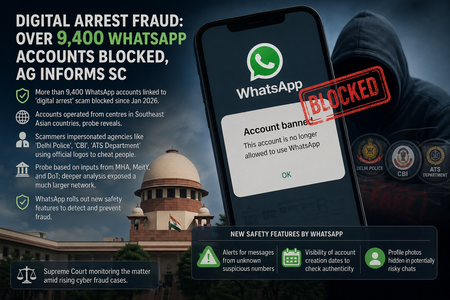
More than 9,400 WhatsApp accounts associated with India have been banned for their involvement in the ‘digital arrest’ scam since January 2026, as revealed by Attorney General R. Venkataramani to the Supreme Court. The Attorney General presented this information in a note submitted to the court, which is addressing the increasing incidents of ‘digital arrest’ fraud nationwide.
These accounts were identified and removed by WhatsApp as part of an internal investigation targeting organized scam networks that prey on Indian users. Investigations unveiled that many of these fraudulent accounts were operated from centers located in Southeast Asian countries, beyond India’s legal jurisdiction.
The ‘digital arrest’ scam entails fraudsters posing as law enforcement or government officials to intimidate victims and extort money. The scammers used deceptive names like ‘Delhi Police’, ‘Mumbai Headquarters’, ‘CBI’, and ‘ATS Department’ on their WhatsApp profiles, along with official-looking government logos as profile pictures to deceive unsuspecting users.
WhatsApp’s deeper analysis, prompted by inputs from various government agencies including the Indian Cyber Crime Coordination Centre, the Ministry of Electronics and Information Technology, and the Department of Telecommunications, revealed a more extensive network of fraudulent accounts. This led to the removal of thousands more accounts beyond the initial 3,800 fake accounts identified by government agencies.
The company informed the court of its enhanced measures to combat such scams, including alerts for suspicious first-time messages from unknown numbers, displaying account creation dates for user verification, and automatically concealing profile photos in potentially risky chats. WhatsApp stressed its commitment to dismantling entire scam networks to prevent further misuse of its platform, moving beyond individual complaint-based actions.
The Supreme Court is actively monitoring the situation, given the escalating complexity and transnational nature of cyber frauds targeting Indian citizens.
