


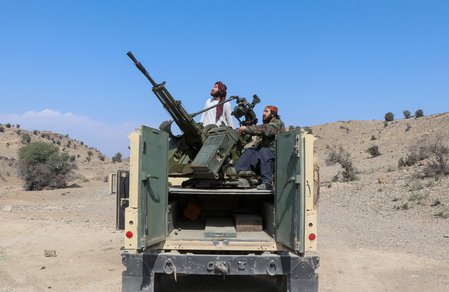
Pakistan is attempting to portray itself as a nation besieged by militants from Afghan territory, necessitating unilateral military action for citizen protection. However, historical context reveals contradictions in this narrative. Since the late 1970s, Pakistan has played a significant role in fostering militancy in Afghanistan, utilizing proxy warfare and treating Afghanistan more as a strategic tool than a sovereign neighbor.
Following the Soviet invasion of Afghanistan in 1979, Pakistan emerged as a key base for the anti-Soviet jihad, supported by substantial aid from the US and Saudi Arabia. The Inter-Services Intelligence (ISI) controlled the flow of resources to Afghan fighters, with refugee camps evolving into militarized hubs for recruitment and training.
During the 1990s Afghan civil war, Pakistan intensified its support for the Taliban, viewing them as a means to exert influence in Afghanistan and counter Indian interests. By 1996, Pakistan was among the few nations recognizing the Taliban regime, showcasing a deliberate strategic approach rather than mere oversight.
Despite publicly aligning with the global ‘war on terror’ post-2001, Pakistan maintained a selective stance, tolerating or sheltering certain militant groups, like the Haqqani Network, which operated freely from Pakistani soil. This dual policy led to accusations from Afghan authorities of playing a double game, further straining relations.
Pakistan’s strategy of using Afghanistan for strategic depth against India has perpetuated instability in the region, with militants turning against the Pakistani state over time. This approach has not only fueled violence internally but also destabilized Afghanistan, leading to decades of conflict and insecurity.
As tensions escalate between Afghanistan and Pakistan, the fragile alliance built on shared interests has crumbled, with border disputes adding to the hostility. Pakistan’s reliance on militancy as a tool of influence has backfired, necessitating a reevaluation of its policies to restore regional stability and mutual trust.
