


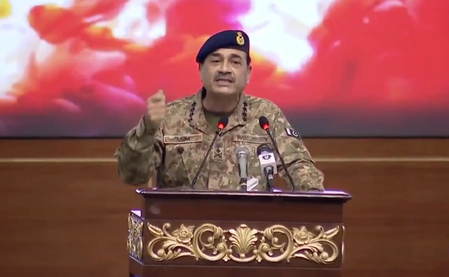
The Pakistani Armed Forces trace their origins back to British India’s colonial history. After the partition, Pakistan inherited the Muslim segment of the British Indian Army, while India remained secular. Over time, Pakistan’s military increasingly used religion to motivate forces, especially in its rivalry with India.
Ayub Khan, the first native Pakistani Commander-in-Chief, initially had little interest in religion as an ideological force. However, a new generation of nationalist officers emerged under his rule, aiming to transform the army into a more nationalistic force. They linked the army to an Islamic past, elevating historical Muslim figures as symbols of military heritage.
During the 1965 Indo-Pakistani War, Ayub Khan and Zulfikar Ali Bhutto planned ‘Operation Gibraltar’ to seize Jammu and Kashmir, drawing on Islamic history for symbolism. The Pakistani military, influenced by the belief that one Pakistani soldier equals ten Indian soldiers, named its missile systems after historical Muslim figures, connecting modern identity to Islamic history.
Under General Zia-ul-Haq, the military projected itself as defenders of Islam, altering its guiding motto and emphasizing religious identity. The army’s Islamization intensified, with officers’ religious practices becoming institutionalized, especially under Zia’s leadership. The geopolitical climate, including the Soviet invasion of Afghanistan, further catalyzed Islamization within the Pakistani military.
Asim Munir, the current Chief of the Army Staff, continues the trend of religious symbolism in the military. His leadership style emphasizes religious identity, portraying the army as a guardian of both state and faith. Munir’s public image as a “Defender of the Faith” underscores the consolidation of the military’s Islamization under his command.
