


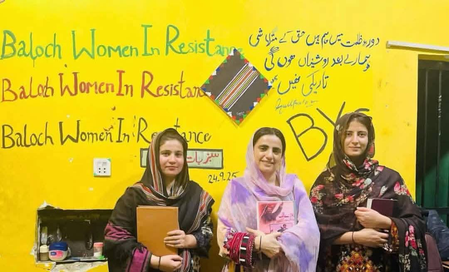
Several members of Pakistan’s Sindh Bar Council have strongly criticized the life sentences given to Baloch activists, including Mahrang Baloch, leader of the Baloch Yakjehti Committee (BYC). They expressed concerns about the fairness and independence of the proceedings that led to the verdict. The Pakistani Anti-Terrorism Court recently sentenced four activists, including Mahrang Baloch, to life imprisonment for their alleged involvement in the killing of a Frontier Corps official.
The court also handed life sentences to Baloch Students Organisation (BSO) Chairman Balach Qadir, central leader Abu Bakr Kalanchi, and BYC leader Sibghatullah Shahji. Members of the Sindh Bar Council emphasized that the essence of the law lies in the integrity of the judicial process, not just in the severity of punishments. They stated that courts should protect liberty, prevent arbitrariness, and uphold human dignity.
In a released statement, the members highlighted that dissent is not a crime and peaceful advocacy for civil liberties should not be misconstrued as disloyalty to the state. They asserted that the right to question authority and advocate for justice is fundamental in a democratic society. The signatories rejected the notion that civil rights activism poses a threat to the state, emphasizing that those advocating for human dignity and constitutional freedoms are champions of democratic ideals.
According to the statement, any society claiming to uphold the rule of law cannot suppress voices of conscience or criminalize dissent. They criticized proceedings that prioritize expediency over justice and compliance over morality. The signatories stressed that punishing individuals for exercising their rights does not showcase the state’s strength but rather its insecurity.
