


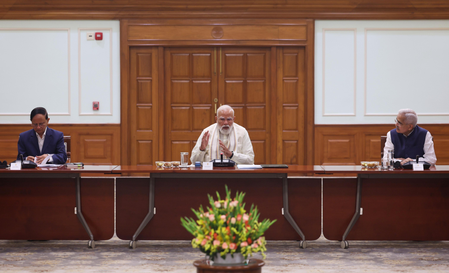
Prime Minister Narendra Modi led a session of the Economic Advisory Council to the Prime Minister (EAC-PM) to discuss sustaining India’s growth, enhancing economic resilience, and managing global challenges amidst the West Asia conflict. The meeting emphasized strategies to boost economic growth further, especially in the face of geopolitical uncertainties, supply chain disruptions, and weakening global demand.
PM Modi and council members deliberated on policy measures to uphold India’s growth trajectory while ensuring macroeconomic stability in a complex global landscape. The discussions also revolved around reforms to enhance ease of living and ease of doing business, focusing on improving governance efficiency, reducing compliance burdens, and fostering a favorable environment for investment and entrepreneurship.
Moreover, the meeting addressed the implications of the West Asia conflict, analyzing its potential impact on India and the global economy. Concerns regarding energy markets, trade routes, and overall economic stability were examined as prolonged tensions in the region continued to create uncertainty in global markets.
The gathering is significant as India remains one of the fastest-growing major economies despite mounting global uncertainties and geopolitical tensions. India’s GDP growth stood at a robust 7.8 percent in the January-March quarter of 2025-26, with the full financial year recording a growth rate of 7.7 percent, driven by strong performances in agriculture, construction, and services sectors.
India, a significant importer of energy, closely monitors developments in the region amid fears that sustained instability could impact crude oil prices and international trade flows. The Economic Advisory Council to the Prime Minister, comprising economists and policy experts, offers independent insights on economic and developmental matters, advising the government on long-term growth priorities and emerging economic trends.
