


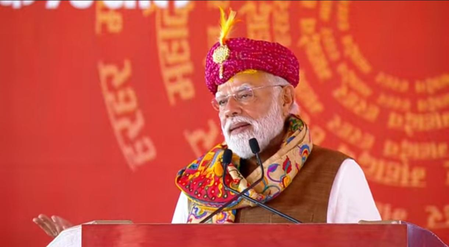
Prime Minister Narendra Modi, speaking at the ‘Somnath Amrut Mahotsav’ in Gujarat, criticized the practice of “appeasement politics.” He highlighted that India’s first Prime Minister, Jawaharlal Nehru, had opposed the reconstruction of the Somnath Temple post-Independence. PM Modi emphasized that the rebuilding of the temple in 1951 signified India’s independent civilizational identity after gaining freedom.
The Prime Minister commended Sardar Vallabhbhai Patel and Dr. Rajendra Prasad for their support in the temple’s reconstruction following Independence. He credited Sardar Patel for uniting over 500 princely states to shape a modern India and showcasing India’s journey to reclaim its ancient glory through the restoration of Somnath.
PM Modi acknowledged the challenges faced by Sardar Patel and Dr. Rajendra Prasad during the reconstruction process, particularly the opposition from Nehru. He highlighted Sardar Patel’s unwavering determination in rebuilding the Somnath Temple despite facing resistance, leading to the restoration of India’s pride and heritage.
Linking the historical event to contemporary politics, PM Modi cautioned against prioritizing appeasement over national self-respect. He urged for a shift away from narrow politics towards a harmonious blend of development and heritage. The Prime Minister described the Somnath Amrut Mahotsav as an inspirational celebration for India’s future, not just a reflection of the past.
PM Modi also mentioned various temple redevelopment projects undertaken nationwide, including Kashi Vishwanath Dham in Varanasi, Mahakal Mahalok in Ujjain, Kedarnath reconstruction, and the Ram Temple in Ayodhya. He highlighted the revival of rich traditions through these projects within a short span of 10 to 12 years.
Earlier in the day, PM Modi participated in the Kumbhabhishek ceremony at the Somnath Temple alongside Chief Minister Bhupendra Patel and Deputy Chief Minister Harsh Sanghavi. The event commemorated 75 years since the temple’s inauguration in 1951.
