


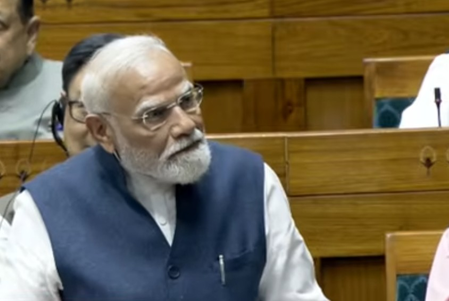
Prime Minister Narendra Modi emphasized the transformative potential of the Women Reservation Bill in reshaping the direction and condition of Indian politics by involving half of the nation’s population in decision-making. He highlighted the significance of this move in achieving Viksit Bharat @2047 and noted that those opposing the bill have been taught a lesson by women voters. PM Modi urged political parties to view this initiative as a means to redefine the nation’s politics and enhance democracy.
The Lok Sabha recently approved the introduction of the Constitution (One Hundred and Thirty-First Amendment) Bill, 2026, following a division of votes initiated by the Opposition. Union Law Minister Arjun Meghwal presented the Bill in the House, marking a crucial step in the legislative process. This development came after an earlier round of voting where Members of Parliament supported bringing the Bill forward for discussion, along with the Delimitation Bill 2026 and Union Territories Laws (Amendment) Bill 2026.
During the voting process, the Lok Sabha witnessed a division with 251 members in favor and 185 against the introduction of the Constitution (One Hundred and Thirty-First Amendment) Bill, 2026. Speaker Om Birla announced the results, emphasizing that they are subject to change. The use of the Automatic Vote Recorder system was employed to register votes under categories of “Ayes,” “Noes,” and “Abstain” in contested outcomes.
The Opposition’s demand for a division during the voting on the Women’s Reservation Bill highlighted the heightened political engagement surrounding the motion. Lok Sabha Secretary General Utpal Singh explained the functioning of the automatic vote recording system to members, clarifying that while voice votes are customary, a division is conducted upon members’ request. Members were also informed about the process of changing votes through slips if necessary, ensuring transparency and accuracy in the voting procedure.
