


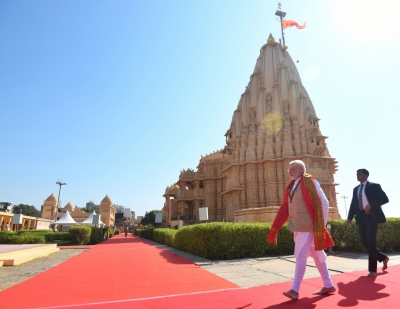
Prime Minister Narendra Modi reflected on the time when former Prime Minister Jawaharlal Nehru opposed the reconstruction of the Somnath Temple, expressing reluctance for top constitutional figures to be involved. After the temple was desecrated in 1026, Sardar Vallabhbhai Patel took on the task of rebuilding it post-Independence. Sardar Patel’s visit to the site in 1947 during Diwali deeply impacted him, leading to the decision to restore the temple at its original location.
On May 11, 1951, the grand reopening of the Somnath Temple took place in the presence of Dr. Rajendra Prasad. Despite Nehru’s reservations about government involvement in the restoration, Sardar Patel, K.M. Munshi, and President Rajendra Prasad strongly advocated for the temple’s reconstruction as a symbol of national pride. The restoration was funded through public donations rather than government resources.
PM Modi emphasized the significance of K.M. Munshi, a key supporter of Sardar Patel, in the restoration of the temple. Munshi’s literary works, particularly ‘Somanatha: The Shrine Eternal,’ were praised by PM Modi for their informative nature. The title of Munshi’s book reflects India’s enduring belief in the perpetuity of spirit and ideas.
2026 marks a millennium since the initial attack on the Somnath Temple in January 1026. PM Modi underscored the temple’s role as a timeless declaration of the Indian ethos, asserting that while hatred and extremism may cause temporary destruction, faith and commitment to goodness possess the ability to create eternally.
