


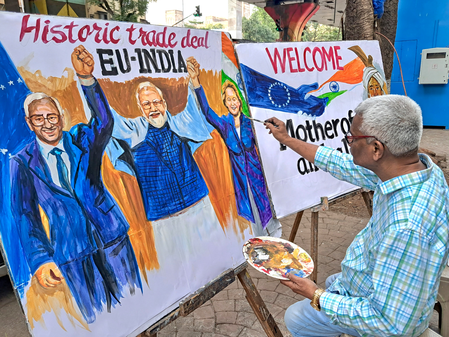
Prime Minister Narendra Modi recently visited four European nations to strengthen strategic ties and enhance India’s economic engagement with the European Union (EU). The tour holds significance in diversifying India’s external economic relations and gaining access to broader markets, as per a report by the Politeia Research Foundation (PRF). The PRF report highlights the importance of the India-EU free trade agreement in enhancing economic cooperation.
In 2024, the EU stood as India’s second-largest trading partner after China, accounting for 11% of India’s global trade. Conversely, India was the EU’s tenth-largest trading partner, representing only 1.7% of the EU’s global trade. This indicates the potential for growth in India-EU trade relations, with the free trade agreement aiming to boost Indian exports to the EU and improve market access for EU companies in India.
The EU-India FTA is expected to facilitate stronger Indian export growth to the EU by eliminating tariffs on over 90% of tariff lines, covering 91% of the trade value. This move creates opportunities for India to enhance its export capabilities and increase its share of EU imports. Additionally, the agreement is projected to enhance EU’s presence in high-value sectors and provide India with access to advanced technologies and industrial inputs.
The free trade agreement addresses tariff discrepancies that Indian exporters have faced in sectors like textiles and apparel when compared to competitors like Bangladesh, Pakistan, and Turkey. By improving India’s tariff treatment in the EU’s textile and apparel market, the FTA supports export diversification and strengthens India’s employment-intensive sectors. This move not only has commercial benefits but also contributes to developmental goals by promoting job creation and supporting small-firm participation.
The EU-India FTA includes commitments on trade in services, particularly benefiting India due to its strength in ICT and business services. The agreement is expected to enhance services trade between the regions and potentially boost the expansion of Global Capability Centres in India. By providing predictability for cross-border services supply and fostering stronger ties between Indian service providers and European clients, the FTA aims to enhance economic cooperation between India and the EU.
