


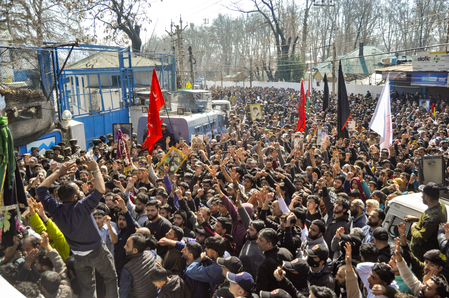
Despite authorities imposing restrictions to maintain law and order, pro-Iran protests persisted across the Kashmir Valley. Clashes between security forces and protesters were reported in various locations. Police and security personnel were heavily deployed, especially in Shia Muslim-dominated areas like Srinagar city.
Barricades were set up at Lal Chowk in the city center, where a large gathering of protesters voiced anti-United States and anti-Israel sentiments. Educational institutions remained closed, and exams scheduled for Monday and Tuesday were postponed. Movement of people and vehicles was limited, and internet speeds were reduced to curb the spread of provocative content on social media.
The protests, triggered by the reported killing of Iran’s Supreme Leader Ayatollah Ali Khamenei in joint airstrikes by the US and Israel, entered a second day. Demonstrations were observed in various areas like Bemina, Budgam, and Pulwama, with protesters marching through streets chanting anti-US and anti-Israel slogans. Security forces resorted to using lathis and tear smoke shells in some places to disperse crowds.
Mirwaiz Umar Farooq, the chief cleric and chairman of the Mutahida Majlis-e-Ulama (MMU), called for a protest shutdown, which received support from political parties like the Peoples Democratic Party (PDP). The Kashmir Valley, home to around 16 lakh Shia Muslims, saw heightened security measures supervised by senior police officers, including Director General of Police (DGP) Nalin Prabhat. Instructions were issued to security forces to use force only when absolutely necessary to maintain order.
