


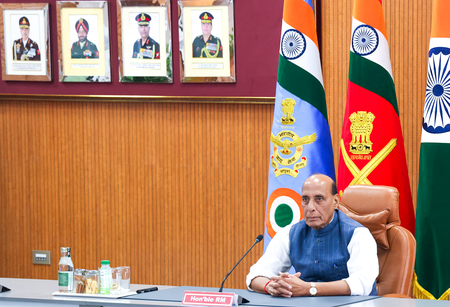
Defence Minister Rajnath Singh, at the Joint Commanders’ Conference in Jaipur, emphasized the importance of staying prepared for the future by learning from ‘Operation Sindoor’ and adapting to global security changes. He highlighted the need to boost India’s capabilities in artificial intelligence, cyber resilience, autonomous systems, and multi-domain warfare. Singh praised ‘Operation Sindoor’ as a successful operation that demonstrated India’s military strength and determination to protect national interests.
Singh stressed the significance of strengthening capabilities in artificial intelligence, autonomous systems, data analytics, and secure communication networks to tackle the evolving geopolitical security landscape. He pointed out that future conflicts would involve hybrid threats, information dominance, and operations across various domains. Singh also emphasized the necessity of integrated national preparedness across all conflict spectrums to address emerging technologies’ impact.
The Defence Minister commended the progress made in enhancing jointness, integration, and technological adoption across the three Services. He highlighted the importance of innovative thinking and enhanced synergy in winning future wars, beyond just relying on weaponry. Singh urged Commanders to maintain unpredictability to adversaries by cultivating the “element of surprise” while remaining vigilant against surprise tactics.
Singh reiterated the government’s commitment to strengthening defence forces with advanced weapons and platforms, focusing on research in specialized domains. He released a documentary on Operation Sindoor during the conference, emphasizing the nation’s readiness and decisive response capabilities. Singh also unveiled Vision 2047 and the Joint Doctrine for Integrated Communication Architecture to enhance doctrinal clarity and interoperability across the Armed Forces for future operations.
The conference, themed “Military Capability in New Domains,” brought together top leadership to discuss emerging security challenges, technological advancements, and joint capability development. Discussions included cognitive warfare, cyber resilience against evolving threats, indigenous innovation, and AI-enabled warfighting concepts. Advanced systems for intelligence fusion, operational planning, and information management were demonstrated, showcasing the integration of cutting-edge technologies into joint operational structures.
