


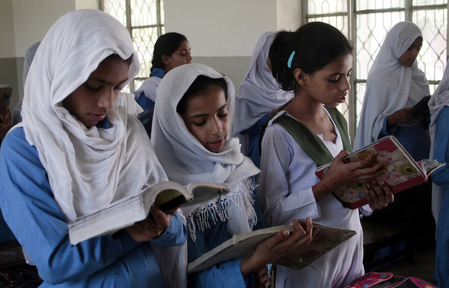
As Pakistan commences its new academic year, families are grappling with the financial strain of purchasing school supplies for their children. The cost of enrolling a single child in school, including fees for the first month and buying textbooks, notebooks, uniforms, shoes, and a bag, ranges between PKR 20,000 to PKR 30,000. This surge in expenses has led to public outcry and protests against the escalating educational costs in the country.
Moreover, there is a significant shortage of new textbooks, with a reported 40% deficit in the market this year. Families are facing increased expenses related to schooling, with uniforms priced at around PKR 3,000, school shoes ranging from PKR 2,500 to PKR 5,000, and basic quality school bags starting at PKR 1,500, according to The Express Tribune. The additional cost of applying a plastic cover to a single book varies from PKR 75 to PKR 100, while larger notebooks and registers are priced between PKR 120 to PKR 130.
Concerns have been raised by parents regarding the intentional inflation of costs, which they believe is a deliberate attempt to make education unaffordable for low-income families, thereby limiting access to quality education. The rising financial burden associated with education in Pakistan contrasts with the free education and healthcare available in many other parts of the world, exacerbating the challenges faced by economically disadvantaged families.
The educational landscape in Pakistan faces significant disparities, as revealed by a recent report indicating that 28% of children aged 5-16 years are not enrolled in school. Alarmingly, girls are disproportionately affected, with 34% of girls compared to 22% of boys not receiving formal education. These disparities are more pronounced in rural areas, particularly for girls, underscoring the intersection of gender and geography in educational access.
Despite efforts to improve literacy rates, access to education remains unequal in Pakistan, with two-thirds of Pakistanis aged 10 years and above having attended school at some point. The national literacy rate stands at 63%, with male literacy at 73% and female literacy at 52%. Urban areas exhibit higher literacy rates at 77% compared to 56% in rural regions. However, enrollment rates decline significantly at higher education levels, with only 40% of children attending middle school and approximately 30% progressing to matriculation.
The challenges faced by students, particularly in rural and marginalized areas, contribute to a sharp decline in the number of students continuing their education beyond primary levels. Structural barriers such as safety concerns, long distances to schools, and increasing opportunity costs, especially as children age, pose significant obstacles to educational continuity. Financial pressures, domestic obligations, and limited post-primary schooling options further impede children’s access to education, with girls facing additional barriers due to societal expectations and early marriage pressures.
