


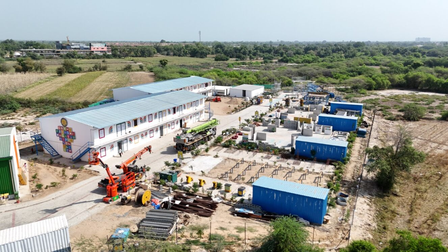
A skills training institute in Vadnagar town of Gujarat’s Mehsana district has started full-scale operations. The Industrial Construction Skills Training Institute (ICSTI), set up by a private engineering and construction firm with support from the Gujarat government, has finished training for two pilot batches of 201 trainees. These trainees have now been deployed to various major infrastructure projects across the country after completing short-term, industry-oriented courses.
The focus of this initiative is to offer practical, job-linked training that aligns with the demands of large-scale infrastructure projects. Trainees who completed courses of 45, 60, and 90 days are now actively working on projects like the semiconductor fabrication facility in Dholera, the Ahmedabad-Mumbai high-speed rail corridor, and other significant ventures. They are receiving monthly stipends ranging from Rs 18,000 to Rs 20,000.
The training campus, spread over approximately 9.3 acres, is equipped with specialized hands-on training infrastructure. This includes practical models for simulation-based learning, such as transmission tower structures used for training in erection and dismantling processes. Niranjan Mishra, the head of ICSTI-Vadnagar, mentioned that the training system is designed to meet international standards, following the guidelines of the UK Construction Industry Training Board.
Trainees are assessed and placed into different skill levels based on their performance. They are categorized into Level-2, Level-3, and Level-4 according to their skills in respective trades. After completing their training, candidates are engaged in major construction and hydrocarbon projects under various schemes, providing a total of 33 months of stipend-based engagement.
The institute offers training in over 20 trades covering construction, manufacturing, and emerging industrial sectors. The program is open to both men and women, with separate residential facilities provided on campus. No fees are charged from trainees, and accommodation along with meals is provided free of cost. The training model includes open-yard workshops and simulated construction environments where trainees work with steel and concrete components before being deployed to live infrastructure projects.
