


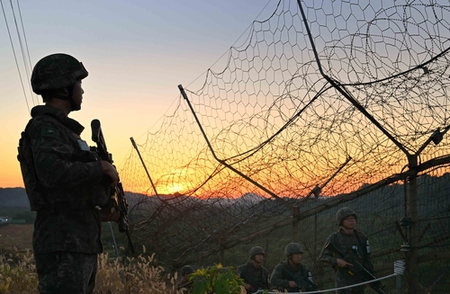
South Korea’s surveillance of North Korea remains unaffected by US restrictions on intelligence sharing, despite concerns raised after the unification minister disclosed a nuclear facility site in Kusong. While there have been some limitations on intelligence sharing from the US, Seoul’s satellite assets have ensured the continuity of its intelligence gathering capabilities.
A military surveillance satellite launched in November is nearing full operational status this month after successful deployment tests, increasing the total number of surveillance satellites capable of distinguishing individual vehicles on the ground to five, as reported by Yonhap news agency. Moreover, the upcoming deployment of Arirang 7, a multipurpose satellite equipped with advanced imaging technology, is scheduled for July, enhancing South Korea’s monitoring capabilities.
Following Unification Minister Chung Dong-young’s public identification of North Korea’s Kusong region as a site for uranium enrichment facilities, the United States reportedly expressed concerns, suggesting that the information might have been obtained from shared intelligence. However, the unification ministry clarified that the minister’s disclosure was based on publicly available information, not intelligence shared by Washington.
