


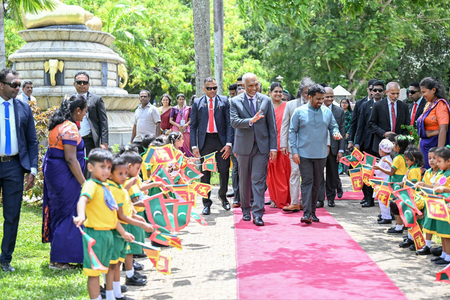
Sri Lanka and the Maldives inked seven memoranda of understanding as part of Maldivian President Mohamed Muizzu’s State Visit to Colombo, as announced by the President’s Media Division (PMD). The agreements encompass cooperation in tourism, education, higher education, health, sports, youth development, archives, and defense, according to the PMD. President Muizzu’s arrival in Sri Lanka for a three-day State Visit, at the invitation of Sri Lankan President Anura Kumara Dissanayake, marks his first official trip to the country since taking office in 2023, as reported by Xinhua news agency.
The State Visit commenced with an official welcome ceremony for President Muizzu at the Presidential Secretariat in Colombo. Subsequently, the two leaders engaged in discussions and issued a joint media statement outlining the outcomes of their talks. President Dissanayake expressed gratitude to the Maldivian government for its humanitarian aid during a recent disaster period and emphasized the shared challenge of climate change faced by both nations.
During the visit, President Dissanayake encouraged Maldivian investors to explore opportunities in various sectors such as information technology, artificial intelligence, fisheries, agro-processing, tourism, real estate, and urban development infrastructure. Additionally, both countries agreed on reciprocal land allocations for their respective diplomatic missions, with Sri Lanka assigning land in Colombo for the Maldivian High Commission and the Maldives reciprocating the gesture for the Sri Lankan High Commission.
To commemorate the 60th anniversary of diplomatic relations between the Maldives and Sri Lanka, Presidents Muizzu and Dissanayake participated in a tree-planting ceremony. They planted Horsfieldia iryaghedhi trees, a critically endangered species native to Sri Lanka. During their discussions, President Muizzu praised Sri Lanka’s efforts to overcome socio-economic challenges post the Cyclone Ditwah impact last year. Both leaders reiterated their commitment to enhancing bilateral ties and exploring new avenues for collaboration in areas like hospitality, tourism, healthcare, education, vocational training, and broader socio-economic development.
