


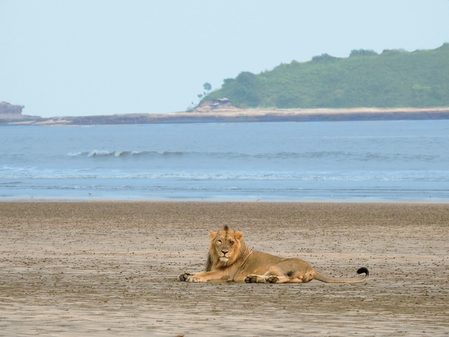
A recent scientific study reveals that Asiatic lions living along Gujarat’s coast predominantly feed on wild prey rather than domestic animals, challenging the notion that they ventured beyond Gir forests in search of cattle. The research, published in the journal ‘Conservation,’ shows that nearly 70% of the coastal lions’ diet consists of wild prey, underscoring the sustainability of their habitat expansion.
With Gujarat’s Asiatic lion population reaching 891 as per the 2025 16th Lion Population Estimation, the study titled ‘Dietary Pattern of Asiatic Lions in the Coastal Ecosystem of Saurashtra, Gujarat, India’ sheds light on the lions’ feeding habits. Analyzing 160 lion scat samples from coastal districts, researchers found that wild prey accounted for 64% of the lions’ diet, with blue bulls (nilgai) being the primary food source.
Contrary to expectations, the study debunks the belief that lions in human-dominated coastal areas heavily rely on livestock due to limited wild prey availability. Healthy populations of nilgai and wild pigs along Gujarat’s coastline enable lions to sustain themselves on natural prey, potentially reducing human-lion conflicts. The coastal ecosystem now supports three significant satellite lion populations, reflecting the species’ expansion beyond Gir forests.
Coastal lions exhibit a specialized diet focused on nilgai and wild pigs, indicating that prey abundance and habitat quality influence their feeding behavior. While cattle and buffalo are part of their diet, much of the consumed cattle are feral animals abundant in Saurashtra, making them easier prey. The study stresses the importance of conserving wild prey for the long-term survival of Asiatic lions outside protected forests.
