


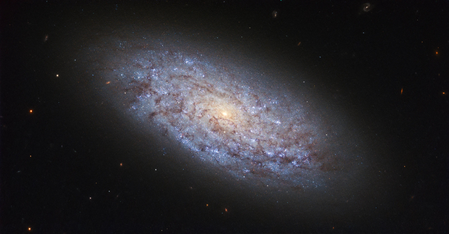
A recent study by Indian scientists explored the potential existence of black holes in dwarf spheroidal galaxies orbiting the Milky Way. Researchers K. Aditya and Arun Mangalam from the Indian Institute of Astrophysics developed models incorporating stars, dark matter halos, and potential central black holes. By analyzing stellar kinematic data, they were able to estimate the mass of any central black hole that might be present.
The study revealed that the models, when combined with observational data, set upper limits on the masses of central black holes in these galaxies, typically below one million solar masses. Arun Mangalam noted that while massive black holes are not a necessity, the data align well with the presence of intermediate-mass black holes instead.
According to the Ministry of Science & Technology, this research holds significance for both theoretical understanding and future astronomical observations. Arun Mangalam emphasized that the study establishes a unified relationship applicable even to the smallest galaxies, serving as a crucial reference point for simulations of galaxy and black hole evolution.
The findings become particularly relevant in light of upcoming advanced observational tools like the National Large Optical Telescope (NLOT) and the Extremely Large Telescope (ELT). These instruments are expected to offer enhanced resolution, facilitating precise measurements of stellar movements in dim, low-mass galaxies. The study’s unified relation provides a solid foundation for interpreting such data, especially in the context of dwarf galaxies where black hole characteristics are subtle.
