


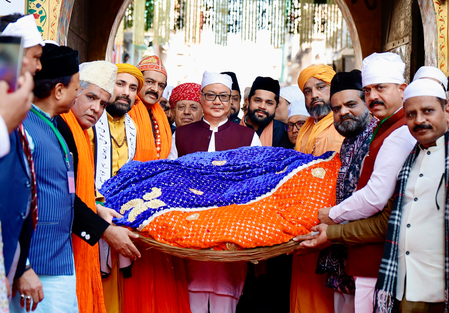
The Supreme Court rejected a PIL questioning the state-sponsored honors given to Sufi saint Khwaja Moinuddin Chishti and the Ajmer Dargah. The Court stated that the relief sought was not within its jurisdiction under Article 32 of the Constitution. It advised the petitioners to pursue their case in a civil court regarding the alleged unauthorized occupation of the Shankat Mochan Mahadev Temple by the Dargah.
The PIL contested the tradition of the Prime Minister and other officials offering a ceremonial chadar at the Ajmer Dargah, deeming it unconstitutional and against India’s constitutional principles. The petitioners argued that there was no legal basis for the government to provide official patronage to the shrine, which they believed contradicted secular governance and national dignity.
According to the PIL, the practice of the Prime Minister presenting a ceremonial chadar at the Ajmer Dargah dates back to 1947 without any legal backing. The petitioners raised concerns about the secular nature of the Prime Minister’s office being compromised by engaging in religious practices. They questioned the historical rationale behind state patronage for Moinuddin Chishti, linking him to past events involving foreign invasions.
The petition urged the apex court to declare the state-sponsored honors to Khwaja Moinuddin Chishti and the Ajmer Dargah as unconstitutional. It also sought guidelines aligned with constitutional morality to prevent such ceremonial glorification in the future. Meanwhile, during the 814th Urs of Khwaja Moinuddin Chishti, Union Minister Kiren Rijiju and Lok Janshakti Party-Ram Vilas chief Chirag Paswan offered chadars at the Ajmer Dargah on behalf of the Prime Minister and the Union government.
