


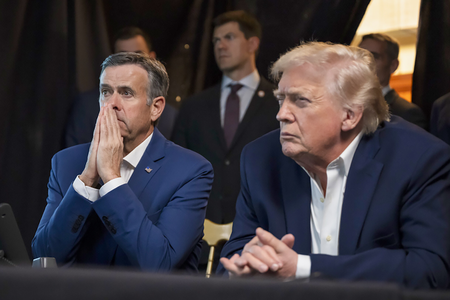
Global media was abuzz as US President Donald Trump proclaimed himself the “Acting President of Venezuela” on his social media platform, Truth Social. The post displayed his “Official portrait, 2025,” identifying him as the “Acting President of Venezuela Incumbent January 2026” and the “45th 47th President of the United States” who “Assumed Office January 2025.”
This declaration, made on a platform launched by Trump four years ago, has triggered varied reactions, from disbelief to strong criticism. It follows a recent US raid in Venezuela that led to the capture of President Nicolas Maduro. In response, Delcy Rodriguez, the former Vice President, has assumed the role of interim President in accordance with Venezuela’s constitution, rejecting US claims and demanding Maduro’s immediate release.
While dual leadership scenarios are uncommon in today’s international arena, historical instances exist. For example, in the British-era Bengal, leaders transitioned to key roles in Pakistan post-Partition. Notably, figures like Abul Kasem Fazlul Huq and Khawaja Nazimuddin held significant positions in both Bengal and Pakistan. Such historical parallels shed light on unique political transitions and arrangements.
Monarchs ruling multiple countries, as seen with King George VI, and revolutionary figures like Simon Bolívar, who held leadership roles across South America, offer additional historical context. However, Trump’s self-declaration lacks formal recognition, especially with an existing interim President in Venezuela.
