


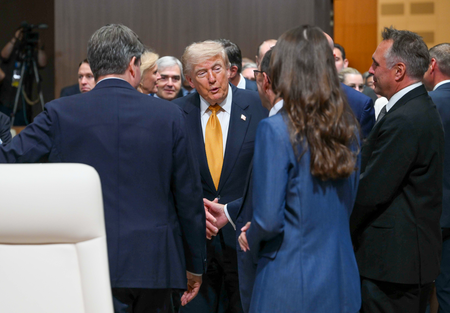
President Donald Trump stated that the US military campaign against Iran has significantly weakened Tehran’s military and nuclear capabilities. Trump emphasized that the primary goal was to prevent Iran from acquiring a nuclear weapon, claiming success in denuclearizing Iran and severely degrading its military strength. He highlighted the destruction of Iran’s air force, navy, radar systems, and leadership, asserting that Iran’s missile capability had also been severely impacted.
Trump mentioned that Iran had resumed attacks despite seeking a pause for funeral proceedings, leading to a strong US response. He indicated that US forces targeted Iranian assets threatening shipping in the Strait of Hormuz, including underground facilities storing drones and missiles. Trump suggested the possibility of imposing a maritime blockade on Iran and emphasized a swift and robust response to any future provocations.
While expressing skepticism about further negotiations with Iran due to alleged bad faith in previous talks, Trump refrained from formally ending discussions. He acknowledged the efforts of his envoys in ongoing negotiations and hinted at the potential involvement of key figures like Steve Witkoff and Jared Kushner. NATO Secretary General Mark Rutte supported the US actions, emphasizing the necessity of degrading Iran’s nuclear and ballistic missile capabilities.
The developments in the Strait of Hormuz, a critical global energy corridor, have raised concerns about potential impacts on energy prices, shipping insurance, and regional security dynamics. The situation remains tense, with both sides closely monitoring each other’s actions to prevent further escalation.
