


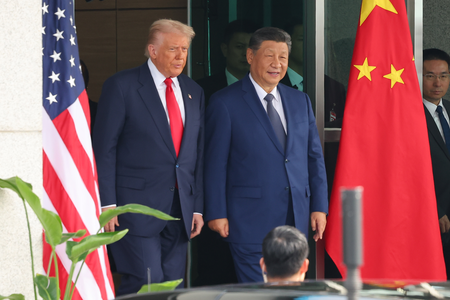
President Donald Trump announced that he will be traveling to China in April to hold a summit with Chinese President Xi Jinping. Trump expressed anticipation for the meeting, noting that Xi is expected to visit the United States later in the year. The relationship between the two leaders was described as positive, with Trump emphasizing the current strong ties with Beijing.
During a press briefing at the White House, Trump highlighted the stability of the relationship with China, stating that both countries are currently enjoying a good rapport. While specifics regarding the location and agenda of the April visit were not disclosed by Trump, he mentioned that Xi’s visit to the US would occur later in the year without specifying a precise timeline.
The ongoing dynamics between the US and China are characterized by competition in various sectors such as trade, technology, and security. Disputes over tariffs and semiconductor export controls persist, alongside strategic rivalry in the Indo-Pacific region. Despite these challenges, diplomatic communication between the two nations at high levels has been maintained.
The interactions between the US and China hold significance for India, given the regional implications. India has bolstered its strategic partnership with the US while simultaneously managing its relationship with China. Developments in the Indo-Pacific region, where both countries are major players, are closely monitored across Asia.
US-China relations have experienced fluctuations between cooperation and conflict over the past decade. Trade tensions escalated under Trump’s administration, leading to broader competition in military and technology domains. Nonetheless, summit diplomacy has been utilized to mitigate risks and uphold open channels of communication.
Critics of Trump argue that he has taken a lenient stance towards China in terms of imposing tariffs on Chinese imports, despite the substantial trade deficit that the US has with China.
