


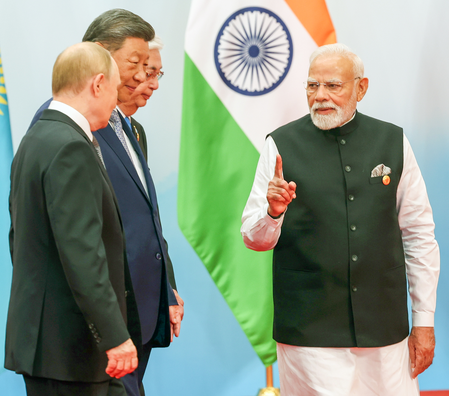
Washington: In an increasingly multipolar world wherein the waning hegemon is bent on disrupting the international order with unilateral coercive tactics, the Shanghai Cooperation Organisation (SCO) Summit, held from August 31 to September 1 in China’s Tianjin, sent some powerful signals.
Particularly since the return of US President Donald Trump, the global trade ecosystem has been subjected to the blows of US protectionism. These policies have included Trump’s sky-high tariffs on imports that flout the free market principles of the liberal world order instituted by the US itself.
However, as hard as the US tries to keep together its declining unipolar position, its desperate measures are giving strengthened impetus for the emerging powers to build alignments and assert autonomy away from the Euro-Atlantic geostrategic frameworks. The recently concluded 25th SCO Summit is remarkable in this light.
Recently, Trump raised the already staggering 25 per cent tariffs on Indian imports to 50 per cent – the additional 25 per cent as penalties for continuing to buy crude oil from Russia. With China, the US is currently on an uneasy tariff truce, conditioned on ongoing negotiations between the two. Yet last week, Trump threatened to enforce a 200 per cent tariff on Chinese imports if Beijing limited its supply of rare-earth magnets to the US. Meanwhile, Russia has been facing sanctions since the beginning of its war with Ukraine, wherein the latter is being aided by the US and other Western powers.
Given this context, the image of Chinese President Xi Jinping, Russian President Vladimir Putin, and Indian Prime Minister Narendra Modi standing tall together at the summit of a regional security and economic grouping of Global South countries carries messaging that is hard to be lost on anyone.
Addressing the congregation of over 20 leaders of non-Western countries, Xi Jinping called out the “bullying” practices, hegemonism, and Cold War mentality of bloc confrontation in the international order and asserted true multilateralism. Even as no direct reference to the US and its tariff policies was made, the respective addresses by the leaders, specifically Xi, PM Modi, and Putin, as well as the Tianjin Declaration, registered unequivocal opposition to unilateral coercive measures, including economic ones, which breach the norms of international law established by the UN and the World Trade Organisation.
While on the one hand, there was ample emphasis on the importance of multilateral institutions, especially in terms of security, economy, and trade, on the other hand, PM Modi brought attention to the necessity of reform in line with the aspirations of the emerging Global South. Expressing this urgency in a poignant way, he stated, “To confine the aspirations of the Global South to outdated frameworks is to deny justice to future generations. The colourful dreams of the new generation cannot be displayed on a black-and-white screen. It is time to change the screen.” And to that end, he proclaimed that the SCO can play a pivotal role in holding the torch of genuine multilateralism and an inclusive world order, framing its three pillars as Security, Connectivity, and Opportunity.
Beyond the rhetorical assertions, the Summit witnessed Xi’s proposal of the Global Governance Initiative (GGI) – advocating an equitable multipolar world order centred on the UN and its international rule of law, sovereign equality, and countering unilateralism through practical political, security, and economic coordination and solidarity. In this direction, there was also the expression of commitment towards the establishment of an SCO development bank to offset members’ dependence on Western financial aid that inevitably comes with problematic conditions.
Additionally, China pledged $280 million in grants to SCO member states this year and $1.4 billion in loans to the member banks of the SCO Interbank Consortium over the next three years. Furthermore, the joint declaration also mentioned the members’ commitment towards AI cooperation, reflecting their collective willingness to develop mechanisms for technological stride, innovation, and most importantly, autonomy.
Therefore, it appears that what was intended to buttress US hegemony as per Trump’s planning has massively backfired and resulted in exactly what Washington feared – a strengthened Global South collective. The fact that India and China, which have been long-time strategic rivals, set aside their differences and initiated bilateral rapprochement, not only reveals the depth of Washington’s miscalculations, but also exhibits the seriousness of this rising collective of Asian giants.
Through a vociferous advocacy of multilateralism, collectively producing financial alternatives, and actively pursuing technological cooperation, Asia’s leading powers have mounted a formidable counter-narrative to the US’s hegemony. The Tianjin SCO Summit signalled an unmistakable message- unilateral coercion will not go unchallenged in a multipolar world order.
–IANS
scor/as
