


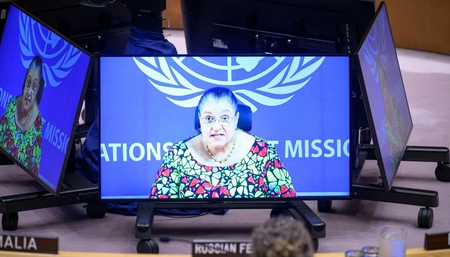
A UN representative for Libya has emphasized the importance of a meeting involving key Libyan stakeholders to address challenges impeding the electoral process. Hanna Tetteh, the UN secretary-general’s special representative for Libya, highlighted the need to tackle obstacles hindering progress towards elections. The proposed roadmap aims to resolve political divisions, unify state institutions, and establish a foundation for long-term stability through national elections.
The roadmap presented by Tetteh last year focuses on three key pillars: implementing a robust electoral framework for presidential and legislative elections, unifying state institutions under a new government, and facilitating a Structured Dialogue for broad citizen participation. Despite efforts, the House of Representatives and the High Council of State have not completed the initial phases of the roadmap after eight months. This situation has prompted a consideration of alternative approaches to advance the political process.
In response to the challenges faced, Tetteh outlined a two-step strategy involving a preliminary meeting to address initial obstacles and a potential broader meeting based on existing political agreements. She clarified that the upcoming meeting is not intended to replace the structured dialogue but will complement it by focusing on specific issues such as the electoral framework and the High National Elections Commission’s board formation. Efforts to break the political deadlock in Libya include the proposal of a “4+4 mini-Committee” comprising members from the General Command of the Libyan National Army and the Government of National Unity.
The committee, consisting of representatives from Tobruk and Tripoli, aims to bridge gaps related to electoral laws and the constitutional basis. A meeting of this committee, scheduled to take place in Rome under UN auspices, is expected to occur soon, as reported by local media citing sources within UNSMIL.
