


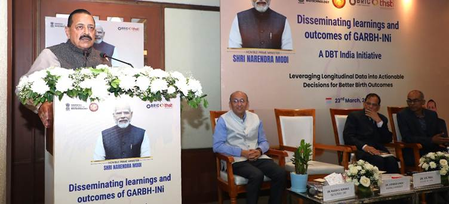
Union Minister of State for Science & Technology, Dr. Jitendra Singh, revealed that India’s GARBH‑INi initiative is conducting a pregnancy cohort study involving 12,000 women to develop AI-driven solutions aimed at preventing preterm births. The study focuses on creating AI-based pregnancy dating models specific to Indian populations, identifying microbiome-based predictors of preterm birth, developing rapid diagnostic tools, and establishing genetic markers for early risk assessment. These efforts are crucial in improving maternal and child health outcomes in India and addressing preterm births, a major cause of neonatal mortality and long-term morbidity.
The GARBH‑INi initiative has successfully enrolled approximately 12,000 pregnant women, forming one of South Asia’s largest pregnancy cohorts. It has also amassed a repository of over 1.6 million well-characterized biospecimens and more than one million ultrasound images to support ongoing research. Dr. Singh emphasized the importance of tailoring solutions to Indian conditions, considering the substantial burden of preterm births borne by the country on a global scale.
Dr. Singh highlighted the program’s holistic approach, which integrates clinical epidemiology, multi-omics biomarkers, and artificial intelligence to provide personalized predictions. Additionally, the initiative has established a national biorepository and the GARBH-INi-DRISHTI data-sharing platform, facilitating broader access for the research community and contributing to global scientific publications. Key partnerships and technology transfer initiatives, including the transfer of microbiome-based biotherapeutics technology, were formalized during the event, aligning with the broader national mission of connecting science with long-term nation-building.
India’s bioeconomy has witnessed significant growth, expanding from nearly $10 billion in 2014 to approximately $195 billion. Dr. V.K. Paul, Member of NITI Aayog, emphasized the need for the program’s next phase to focus on effectively utilizing the developed tools, predictive models, and platforms. The GARBH-INi initiative exemplifies India’s progress in preventive and primary healthcare, underpinned by indigenous innovations, contributing to the country’s global recognition in these domains.
