


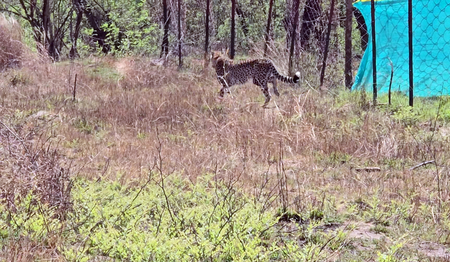
Union Minister for Environment and Forest, Bhupender Yadav, released a fresh batch of nine cheetahs, comprising six males and three females, into Kuno National Park in Sheopur district, Madhya Pradesh. These cheetahs were brought from Botswana to Gwalior airport via an Indian Air Force plane and then airlifted to Sheopur in two helicopters. Initially planned for eight cheetahs, a total of nine arrived and were released at the park, increasing the country’s cheetah population to 48, including 28 cubs born at the park since the first release in September 2022.
Officials have set up multiple quarantine enclosures at the park to facilitate the stress-free transfer of the cheetahs. Following a month-long stay in large, fenced enclosures as part of the protocol, the cheetahs will be monitored by wildlife veterinarians and forest officials to assess their feeding habits, adaptation to the local climate, and overall health. This marks the third batch of African cheetahs introduced to India under a translocation program, with previous imports from Namibia and South Africa.
The recent transfer from Botswana is a part of a government-to-government initiative to establish a genetically diverse, free-ranging cheetah population in India over the next decade. During the quarantine period, expected to last between 15 to 30 days, the cheetahs’ health parameters will be regularly evaluated, including blood samples and fitting them with GPS satellite collars for real-time tracking upon their release into larger soft-release areas.
Since 2023, Kuno National Park has witnessed the birth of 30 cubs, with 28 surviving. In 2023 alone, nine cubs were born in two litters between February 7 and February 18, all of which have thrived to date.
