


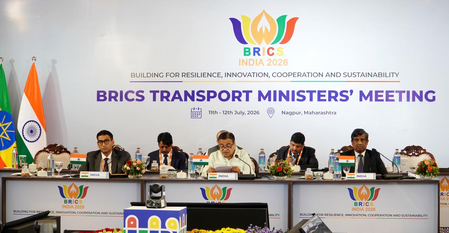
Union Minister for Road Transport and Highways, Nitin Gadkari, emphasized the need for enhanced collaboration among BRICS nations to develop transport systems that are sustainable, resilient, inclusive, and future-ready. Speaking at the third ‘BRICS Transport Ministers’ Meeting’ during India’s BRICS Chairship, he highlighted the shared challenges in infrastructure financing, congestion, emissions, road safety, and last-mile connectivity that demand joint solutions. Gadkari expressed India’s commitment to strengthening ties through knowledge exchange, capacity enhancement, technological partnerships, and collaborative research in areas like green hydrogen, electric mobility, alternative fuels, digital transport systems, and sustainable multimodal infrastructure.
The minister underscored the collective potential of BRICS countries to influence global mobility’s future by fostering innovation, partnerships, and shared responsibilities. Welcoming Transport Ministers and delegates from BRICS Member Countries to Nagpur, Gadkari described the gathering as a significant move towards bolstering transport cooperation among emerging economies. He noted that India’s BRICS chairship theme, “Building for Resilience, Innovation, Cooperation, and Sustainability,” reflects a people-centric, “Humanity First” approach inspired by the concept of Vasudhaiva Kutumbakam.
Gadkari highlighted India’s remarkable progress in the road, rail, maritime, and aviation sectors, citing achievements like the world’s second-largest road network and the development of access-controlled expressways. He mentioned key projects such as the Delhi-Dehradun Economic Corridor, the Sonamarg Tunnel, and extensive Greenfield Expressways as examples of blending infrastructure growth with environmental consciousness and technological advancements. The minister also praised the Hybrid Annuity Model for effectively mobilizing private investments in infrastructure projects.
Furthermore, Gadkari lauded the modernization of India’s railways, including the broad-gauge network’s near-complete electrification, advancements in Vande Bharat services, ongoing work on the Mumbai-Ahmedabad High-Speed Rail Corridor, and notable engineering feats like the new Pamban Bridge. He highlighted initiatives such as the ‘Maritime Amrit Kaal Vision 2047,’ digital programs like e-Navik and e-Samudra, and the Green Shipping initiative as crucial steps towards enhancing maritime infrastructure and optimizing logistics efficiency.
