


The US trade deficit significantly increased in December, with the goods and services gap hitting $70.3 billion, up from $53.0 billion in November. Export figures dropped by 1.7 percent to $287.3 billion, while imports surged by 3.6 percent to $357.6 billion. The goods deficit played a major role in this, soaring by $15.7 billion to $99.3 billion, while the services surplus shrank by $1.6 billion to $29.0 billion.
In December alone, the US goods deficit with India amounted to $5.2 billion. Throughout 2025, the total goods and services deficit stood at $901.5 billion, slightly lower than the previous year. Exports rose to $3,432.3 billion, an increase of $199.8 billion, while imports also saw a rise to $4,333.8 billion, up by $197.8 billion. The goods deficit widened to $1,240.9 billion, with the services surplus growing to $339.5 billion.
The US faced a goods deficit of $58.2 billion with India in 2025, marking India as one of the countries with which the US has a significant trade gap. Comparatively, the US had a goods deficit of $218.8 billion with the European Union, $202.1 billion with China, $196.9 billion with Mexico, $178.2 billion with Vietnam, and $146.8 billion with Taiwan.
Exports of goods dropped by $5.5 billion in December to $180.8 billion, with declines seen in industrial supplies, materials, and non-monetary gold. On the other hand, capital goods exports increased by $2.5 billion, semiconductor exports by $0.9 billion, and consumer goods exports, including pharmaceutical preparations, by $1.8 billion. Imports of goods rose by $10.2 billion to $280.2 billion in December, with notable increases in capital goods, computer accessories, and telecommunications equipment.
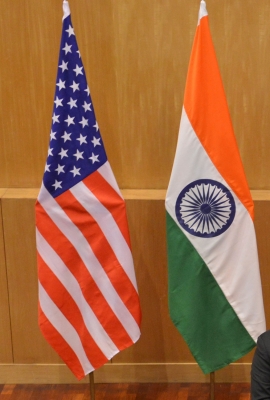
The goods deficit in real terms rose by $12.5 billion, or 14.8 percent, to $97.1 billion in December. These trade figures highlight the growing trade relations between India and the US, with India becoming a significant supplier to the US market as Washington aims to diversify its supply chains across Asia. Trade data play a crucial role in shaping discussions on tariffs, manufacturing, and strategic economic partnerships between the two largest democracies in the world.
