


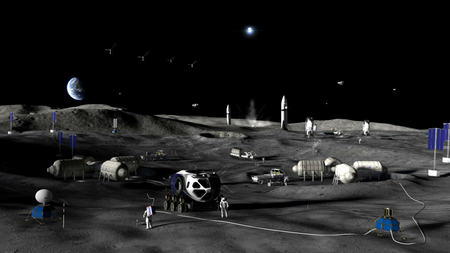
NASA has revealed its strategy to establish a long-term presence on the Moon, including deploying autonomous lunar drones and a vast communications network at the South Pole. The agency aims to support astronauts, cargo systems, scientific missions, and future Mars exploration. A key element of this plan is the “MoonFall” drone mission, which will scout lunar terrain, search for water ice, and prepare landing sites for Artemis astronauts.
The MoonFall drones, developed by NASA’s Jet Propulsion Laboratory, will explore shadowed craters and challenging terrain near the lunar South Pole. These drones will capture high-resolution imagery, map landing sites precisely, and test technologies to withstand the Moon’s extreme temperatures. The drones are set to launch in 2028, carried by a spacecraft built by Firefly Aerospace.
NASA envisions the Moon Base infrastructure as a distributed city spread across hundreds of square miles. Different components, such as habitats, power systems, mining sites, and scientific stations, will be dispersed due to varying conditions on the Moon. Chief architect Nujoud Merancy highlighted that habitats may be located on elevated ridges for sunlight access, while nuclear systems could be kilometers away for radiation safety.
The agency also plans to establish a robust communications and navigation network around the Moon to support the expanding infrastructure. This network will provide essential services like communications, navigation, clock timing, and observation capabilities. NASA Administrator Jared Isaacman emphasized that these efforts mark a significant transformation in space exploration, aiming to achieve missions unique to NASA’s capabilities.
