


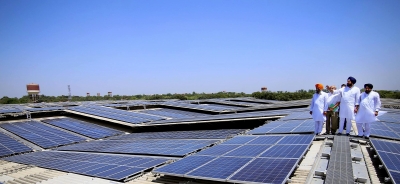
The World Bank’s Board of Executive Directors has given the green light to funding aimed at accelerating India’s national solar rooftops initiative. This initiative seeks to provide clean energy to numerous households and generate 1.7 million job opportunities within the renewable energy sector. India has set ambitious goals, including achieving ‘net zero’ emissions by 2070 and increasing non-fossil-fuel-based energy sources to 60% of its electricity mix by 2035.
To date, while large-scale solar projects have seen significant growth, the adoption of residential solar systems has been limited. In response, the Indian government launched the ‘PM Surya Ghar: Muft Bijli Yojana’ program to promote solar rooftop installations in 10 million rural and urban households nationwide. The program aims to lower household electricity expenses and stimulate local manufacturing of solar rooftop equipment.
Paul Proccee, the World Bank’s Acting Country Director for India, highlighted the institution’s decade-long support for India’s solar rooftop sector. With over $2 billion mobilized, the market has witnessed a surge from 500 MW to over 27 GW of installed capacity. The new financing will further scale up residential solar installations, fostering job creation throughout the supply chain and installation ecosystem.
The financing package for this program comprises an $820 million loan from the International Bank for Reconstruction and Development (IBRD), a $60 million concessional loan from the Clean Technology Fund, and a $10 million grant from IBRD’s Livable Planet Fund. Additionally, the World Bank plans to leverage $4.2 billion in private financing through commercial loans to facilitate household solar rooftop installations.
Moez Cherif, the Task Team Leader of the program, emphasized that this initiative will revolutionize the residential solar market by eliminating financial barriers. It will also enhance the capabilities of distribution companies, banks, and vendors to provide comprehensive service solutions. Through collateral-free financing, households will be able to install solar power systems and significantly reduce their monthly electricity bills.
