


The WhatsApp forwards started before the official statements could catch up. “Nipah outbreak in Bengal!” “Hundreds infected!” “New pandemic coming!” If you’re part of the Indian diaspora, chances are your family group chats have been buzzing with concern, especially if you have relatives in West Bengal or travel plans to India.
Let me cut through the noise with what’s actually happening, because the gap between rumor and reality here is significant.
In a Nutshell:
West Bengal has confirmed only 2 Nipah virus cases since December 2025, not the hundreds rumored online. Both cases involve healthcare workers and are contained through contact tracing. While Nipah is deadly (40-75% fatality rate) with no cure, India’s response has been swift and effective. Asian countries have increased airport screenings as precaution, not panic. Here’s what Indian families abroad need to know about this rare but serious virus, separated from misinformation.
The Real Numbers: Two Cases, Not Two Hundred
According to the Union Health Ministry and National Centre for Disease Control (NCDC), West Bengal has confirmed exactly two cases of Nipah virus disease since December 2025. Both patients are healthcare workers from a private hospital in Barasat, North 24 Parganas district, near Kolkata.
That’s it. Two confirmed cases.
Health authorities traced 196 contacts linked to these cases. All have been monitored, tested, and as of the latest update, all contacts are asymptomatic and tested negative. No new cases have emerged from this contact tracing.
So why does it feel like there’s an outbreak? Because Nipah doesn’t need big numbers to trigger big responses. Even a single case sets off alarm bells, and for good reason.
Why One Nipah Case Matters More Than a Hundred Flu Cases
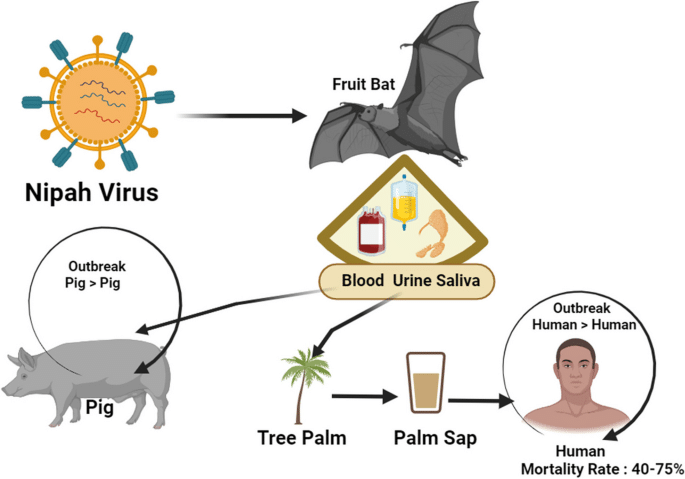
Nipah virus isn’t your regular seasonal flu. It’s classified by the World Health Organization as a priority pathogen, meaning it has epidemic potential that demands urgent attention. The virus carries a fatality rate between 40% and 75%, depending on the outbreak and quality of medical care available.
There’s no approved vaccine. There’s no specific cure. Treatment is purely supportive—managing fever, breathing difficulties, brain swelling—while the body fights the infection on its own.
The virus spreads from fruit bats (Pteropus species) to humans through contaminated fruits, raw date palm sap, or contact with infected animals like pigs. But what makes health officials particularly nervous is that Nipah can spread person-to-person, especially in healthcare settings and among family caregivers. That’s exactly what happened in Barasat, where both confirmed cases are medical staff who likely contracted it while treating an initial patient.
What Nipah Actually Does to the Body
The cruelty of Nipah is that it starts quietly. Early symptoms mimic common viral illnesses—fever, headache, muscle pain, sore throat. You might think it’s regular flu, maybe dengue if you’re in India during monsoon season.
But within days, some patients develop acute encephalitis (brain inflammation). Confusion sets in. Seizures. Respiratory distress. In severe cases, coma and death. The incubation period ranges from 4 to 14 days, sometimes longer, which makes identifying exposure chains complicated.
For diaspora families with elderly parents in India, this progression is particularly concerning. Older adults and those with underlying health conditions face higher risks of severe disease.
The Timeline: How This Unfolded
- Early January 2026: Laboratory tests in West Bengal detected suspected Nipah cases among healthcare workers at a private hospital in Barasat. A National Joint Outbreak Response Team—comprising experts from central and state agencies—was immediately deployed.
- Late January 2026: Two cases officially confirmed. Both are healthcare workers. Extensive contact tracing begins immediately, following established protocols developed from previous Nipah outbreaks in Kerala.
- Current Status: All 196 traced contacts have tested negative and remain asymptomatic. Enhanced surveillance, laboratory testing, and field investigations continue.
- Regional Response: Several Asian countries—Thailand, Nepal, Taiwan, and others—have implemented heightened health surveillance at airports, particularly for travelers from high-risk Indian regions. This includes thermal screening, symptom checks, and health declarations.
These airport measures aren’t evidence of uncontrolled spread. They’re precautionary protocols, the kind implemented whenever a high-fatality pathogen appears anywhere in interconnected travel regions.
Why the Misinformation Spread Faster Than the Virus
Social media has been flooded with exaggerated claims. Some posts mentioned five confirmed cases, others claimed hundreds quarantined, a few even suggested this was “the next COVID.”
Here’s what actually happened: Early reports conflated suspected cases with confirmed cases. Some mixed contact tracing numbers (196 people monitored) with infection numbers. Others simply amplified fear without checking official sources.
The NCDC has specifically addressed this, urging people to rely only on verified information from government health agencies rather than unverified social media claims or sensationalized news reports.
For Indian families living abroad, this distinction matters. You want accurate information to assess actual risk to relatives in India or to your own travel plans, not panic-inducing speculation.
What This Means for the Indian Diaspora
If you have family in West Bengal: The risk remains extremely low. The outbreak is geographically contained to Barasat area, and aggressive contact tracing has identified everyone potentially exposed. Normal life continues in Kolkata and across the state.
If you’re planning travel to India: Current WHO and CDC guidance doesn’t restrict travel to India. Airport screenings in some Asian countries are precautionary. Carry any necessary health documentation, and monitor updates from official health sources before departure.
If you’re sending kids to India for summer: It’s January, so summer plans are months away. The situation will have long resolved by then. Current containment measures are working exactly as designed.
If you’re generally anxious about outbreaks: That’s completely understandable after COVID. But Nipah, despite being more lethal, is far less transmissible than COVID-19. It requires close contact with bodily fluids of infected persons, not airborne spread through casual proximity.
How India’s Response Differs From 2020
One thing worth noting: India’s public health response to Nipah has been textbook-perfect. Immediate detection through existing surveillance systems. Rapid deployment of specialized teams. Transparent communication of actual case numbers. Aggressive contact tracing using protocols refined from Kerala’s previous Nipah outbreaks.
This isn’t March 2020. The systems are better. The protocols are established. The transparency is higher.
Kerala has successfully contained multiple Nipah outbreaks since 2018 using exactly these measures. West Bengal is following the same playbook, and it’s working.

What You Should Actually Worry About (And What You Shouldn’t)
- Don’t worry about: A Nipah pandemic. This virus doesn’t spread easily enough for pandemic-scale transmission. The two confirmed cases haven’t spawned any secondary transmission clusters outside the initial exposure setting.
- Don’t worry about: Travel to India being unsafe. Millions of people live normal lives in West Bengal right now. The containment zone is specific and small.
- Don’t worry about: Consuming fruits or date palm products from India. Commercial products undergo safety protocols, and the virus requires direct contamination from infected bats, which occurs in very specific circumstances.
- Do stay informed about: Official updates from the Union Health Ministry and NCDC. These provide accurate, verified information without sensationalism.
- Do practice basic health hygiene: Whether in India or abroad, avoiding consuming raw date palm sap in endemic areas, maintaining distance if anyone shows acute respiratory or neurological symptoms, and seeking immediate medical care for unexplained fever with neurological symptoms.
The Bigger Picture: Why Nipah Keeps Appearing
Nipah was first identified in 1999 in Malaysia and Singapore among pig farmers. Since then, sporadic outbreaks have occurred in Bangladesh and India, primarily in Kerala and now West Bengal.
Experts point to environmental factors: deforestation, urban expansion into previously wild areas, and climate stress are increasing human contact with fruit bat populations. These bats are the natural reservoir for Nipah, and as human settlements encroach on their habitats, spillover events become more likely.
This isn’t about blame. It’s about understanding that as we reshape landscapes, we encounter pathogens that previously stayed within animal populations. The solution isn’t fear—it’s better surveillance, rapid response protocols, and continued research into vaccines and treatments.
The WHO has flagged Nipah as a priority for exactly this reason. Research continues, and several vaccine candidates are in various stages of development, though none are approved yet.
How many Nipah cases are confirmed in India right now?
Two confirmed cases, both healthcare workers in West Bengal. Both cases have been isolated and treated, with no secondary transmission detected outside the hospital setting.
Can Nipah spread through air like COVID-19?
No. Nipah requires close contact with bodily fluids of infected persons or contaminated materials. It’s not airborne like COVID-19 or measles.
Is there a vaccine or treatment?
No approved vaccine exists yet. Treatment is supportive care—managing symptoms and complications while the immune system fights the infection.
Are people in West Bengal quarantined?
Only the 196 identified contacts were monitored (most at home, not in quarantine facilities). All have tested negative. General population faces no movement restrictions.
What are the early symptoms?
Fever, headache, muscle pain, vomiting, and sore throat—very similar to flu. Severe cases progress to encephalitis (brain swelling), respiratory distress, seizures, and altered consciousness.
What This Really Teaches Us
Two confirmed cases. Zero community transmission. Effective containment protocols. Transparent government communication. These are the actual facts about Nipah in India right now.
But somehow, thousands of people believe an outbreak is raging. This gap between reality and perception reveals something important: we’re still learning to process health information in an age of instant communication and algorithmic amplification.
For the Indian diaspora, this matters doubly. We’re physically distant from family in India, which makes us vulnerable to anxiety when health scares emerge. We rely on information that travels through multiple channels—official media, social media, family WhatsApp groups—each with different reliability levels.
The lesson isn’t just about Nipah. It’s about developing better information hygiene. Checking official sources before sharing alarming news. Understanding that precautionary measures don’t equal crisis-level threats. Recognizing that serious diseases can be serious without being uncontrolled.
India’s public health infrastructure has learned from COVID, from previous Nipah outbreaks, from decades of managing infectious diseases in dense populations. The system isn’t perfect, but it’s functional, responsive, and increasingly transparent.
Two cases. Contained. Monitored. Under control. That’s the story. Everything else is noise, and noise, however loud, doesn’t change facts.
