


Some recipes earn their place in Indian kitchens through complexity, through long ingredient lists and layered techniques that take years to master. And then there’s aloo jeera—a dish that earns its permanent spot on the weekly menu through something far more powerful: pure, unapologetic simplicity.
Two main ingredients. Twenty minutes. One pan. And if you get the technique right, you end up with something so satisfying, so completely right, that you’ll understand why this dish shows up in Delhi school tiffins, Rajasthani dhaba menus, and Navratri fasting thalis with equal ease and enthusiasm.
Table of Contents
What Exactly Is Aloo Jeera?
Aloo jeera—also known as jeera aloo—is a dry potato stir-fry from North India where boiled potato cubes are roasted in ghee with cumin seeds and a handful of simple spices until their edges turn golden and slightly crisp. There’s no gravy. No sauce. No thickening agent. Just potatoes and cumin doing exactly what they were always meant to do together.
The dish is deeply rooted in Punjabi and Rajasthani home cooking, where it’s served with bajra roti at roadside dhabas and packed into school tiffins in equal measure. It has none of the pretension of more elaborate potato dishes—no cream, no cashew paste, no long list of whole spices. It’s the potato at its most honest: cumin-scented, lightly crisped, seasoned with nothing but what it actually needs.
For Navratri fasting, the adaptation is straightforward. Swap regular salt for sendha namak, use ghee instead of oil, skip the asafoetida, and you have a completely vrat-compliant dish that requires almost no modification to its essential character. The cumin is still there. The crispy edges are still there. The simplicity is still there.
Recipe Overview
| Detail | Information |
|---|---|
| Prep Time | 10 minutes |
| Cook Time | 10 minutes |
| Total Time | 20 minutes |
| Servings | 4 people |
| Cuisine | North Indian (Punjabi & Rajasthani) |
| Course | Main Course/Side Dish/Tiffin |
| Diet | Vegetarian, Gluten-Free, Vrat-Friendly (with adaptation) |
| Difficulty Level | Easy |
| Calories per Serving | ~180 kcal |
Ingredients List
| Ingredient | Quantity | Notes |
|---|---|---|
| Boiled potatoes | 500g | Cubed, cooled completely, patted dry |
| Ghee or oil | 2 tablespoons | Ghee preferred for fasting and flavor |
| Cumin seeds | 2 teaspoons | Fresh and aromatic |
| Coriander powder | 1 teaspoon | Ground coriander |
| Turmeric powder | ¼ teaspoon | For color |
| Red chili powder | ½ teaspoon | Adjust to taste |
| Dry mango powder (amchur) | ½ teaspoon | Add at end; prevents bitterness |
| Sendha namak (Rock salt) | To taste | For fasting; use regular salt otherwise |
| Green chili | 1-2 (optional) | Slit; for fresh heat |
| Fresh coriander leaves | For garnish | Chopped |
| Asafoetida (hing) | Pinch (optional) | Skip for strict Navratri fasting |
Why Aloo Jeera Works for Navratri and Everyday Meals
During Navratri, potatoes become one of your most important allies. They’re filling, versatile, and completely vrat-approved. But if you’ve eaten dahi aloo three days in a row and want something with a completely different texture and personality, aloo jeera is the answer.
Here’s what the dish actually does for your body during fasting:
Cumin earns its place. Jeera isn’t just there for flavor. Cumin contains thymol, a compound that stimulates digestive enzymes and helps offset the heaviness that potatoes can sometimes cause, especially when you’re eating them in multiple forms throughout a fasting day. This is why roasting the cumin properly—until it’s aromatic and slightly dark—matters beyond just taste.
Potassium for stamina. With approximately 800mg of potassium per serving, aloo jeera provides serious electrolyte support. When you’re fasting and your eating patterns are disrupted, potassium helps maintain muscle function and fluid balance—particularly relevant if you’re standing through long pujas or dancing during garba nights.
Vitamin C from unexpected places. Potatoes contain roughly 30% of your daily Vitamin C requirement per serving—something most people don’t realize. During fasting, when your diet is restricted and your immune system might feel the strain, that Vitamin C contribution matters.
Moderate glycemic impact. With a glycemic index of around 55, potatoes cooked dry provide steadier energy than you might expect. The roasting process and the fat from ghee both slow the absorption of carbohydrates, reducing blood sugar spikes.
The Three Rules of Perfect Aloo Jeera
Rule One: Completely dry potatoes. Moisture is the enemy of crispness. When you add wet potatoes to a hot pan, the water steams them instead of roasting them, and you end up with soft, pale cubes that never develop that golden crust. After boiling and cubing your potatoes, spread them on a plate and let them cool completely. Then pat them dry with a kitchen towel. Every surface should be dry to the touch before they go anywhere near the pan.
Rule Two: High heat. Aloo jeera needs real heat to develop its characteristic texture. Medium-low heat will steam and soften your potatoes. You want medium-high—hot enough that when a potato cube hits the pan, you hear a genuine sizzle. This is how the edges caramelize and develop that slight crispness that defines the dish.
Rule Three: Never cover the pan. This is the rule that most people break, and it’s the one that ruins the most batches of aloo jeera. Covering the pan traps steam, and steam makes potatoes soft. Leave the pan completely open throughout cooking. Yes, the potatoes might splutter a little. That’s fine. That splutter is the sound of crispness happening.
Get these three things right and you’ll wonder why you ever struggled with this dish.
Step-by-Step Instructions: Making Perfect Aloo Jeera
Step 1: Prepare the Potatoes
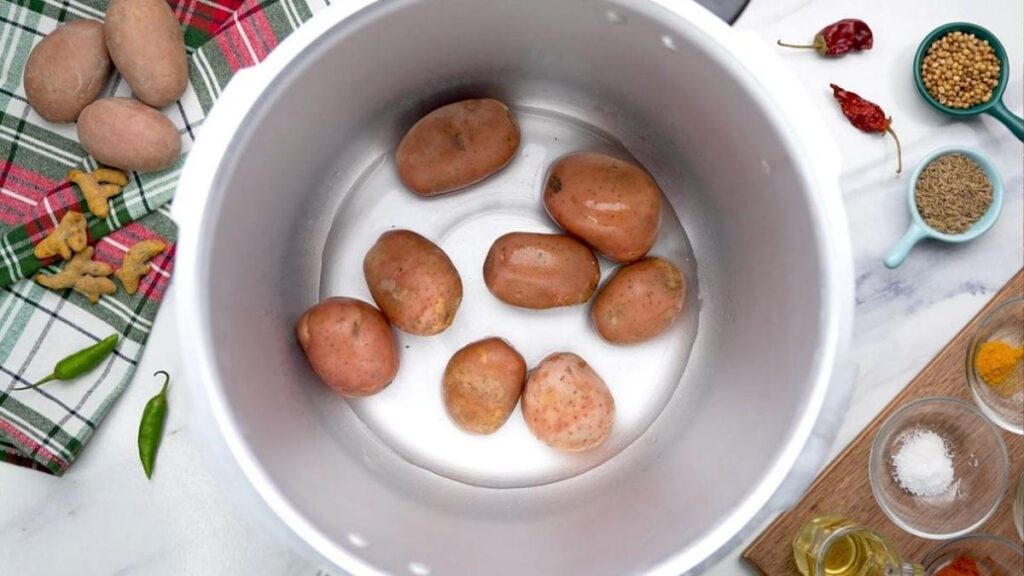
Boil 500 grams of potatoes—preferably waxy rather than starchy varieties, which hold their shape better during high-heat roasting. Boil until fork-tender but not falling apart. You should be able to pierce them cleanly, but they shouldn’t be crumbling.
Time: 10 minutes (plus cooling time)
Step 2: Heat the Ghee and Temper the Cumin
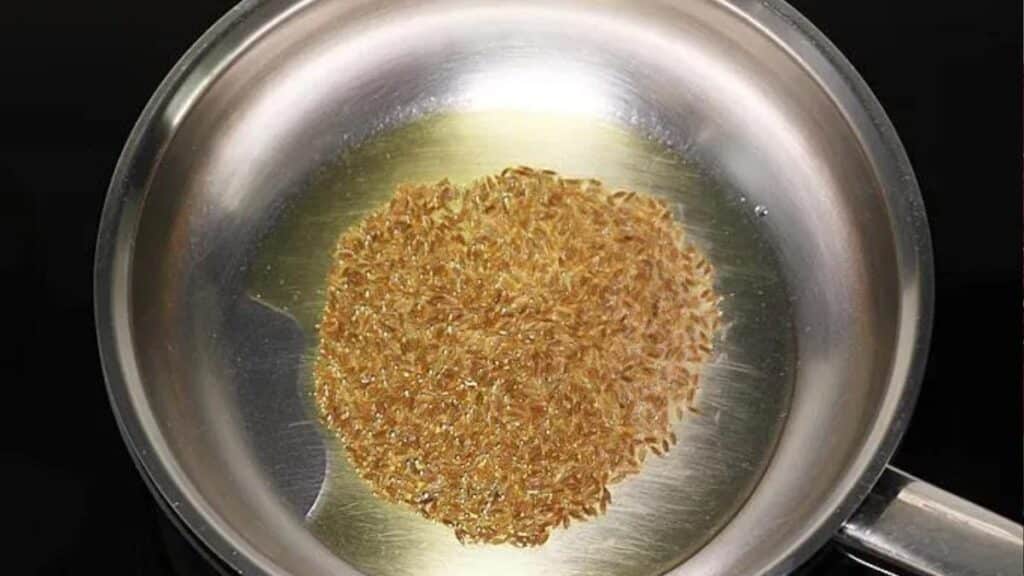
Heat 2 tablespoons of ghee in a wide, heavy-bottomed pan or kadhai over medium-high heat. Wide is better than deep here—you want maximum surface area so the potato cubes can roast in a single layer without crowding.
If using green chilies, add them now and let them sizzle for another 10 seconds.
Time: 1 minute
Step 3: Bloom the Dry Spices
Reduce the heat to medium. Add ¼ teaspoon of turmeric, 1 teaspoon of coriander powder, and ½ teaspoon of red chili powder. Stir the spices into the ghee for just 20 to 30 seconds—enough to bloom them and remove the raw taste without burning. The oil will turn a deep golden color.
Time: 30 seconds
Step 4: Add the Potatoes
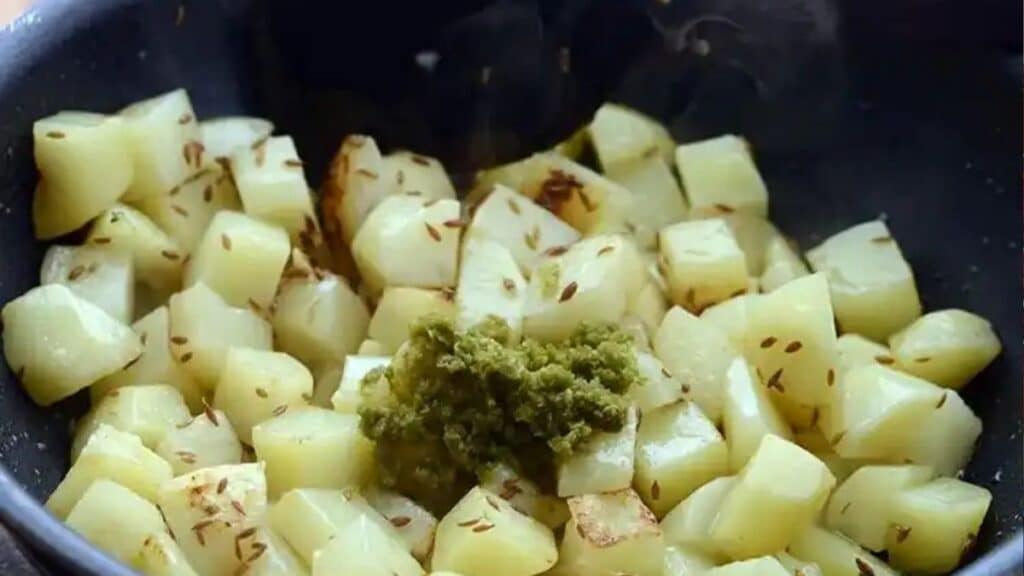
Increase the heat back to medium-high. Add all your dried, cubed potatoes to the pan in one go. Toss them firmly to coat every surface with the spiced ghee. Don’t be gentle—this is a stir-fry, not a gentle turn. Firm tossing helps build that initial crust on the potato surfaces.
Now leave the pan uncovered. This is the rule you cannot break.
Time: 1 minute
Step 5: Roast to Crispness
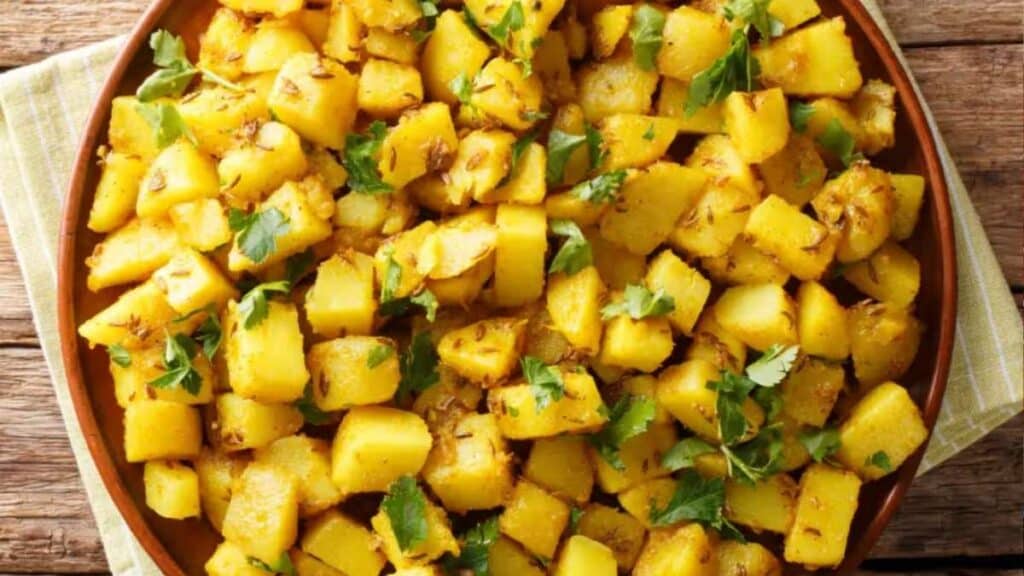
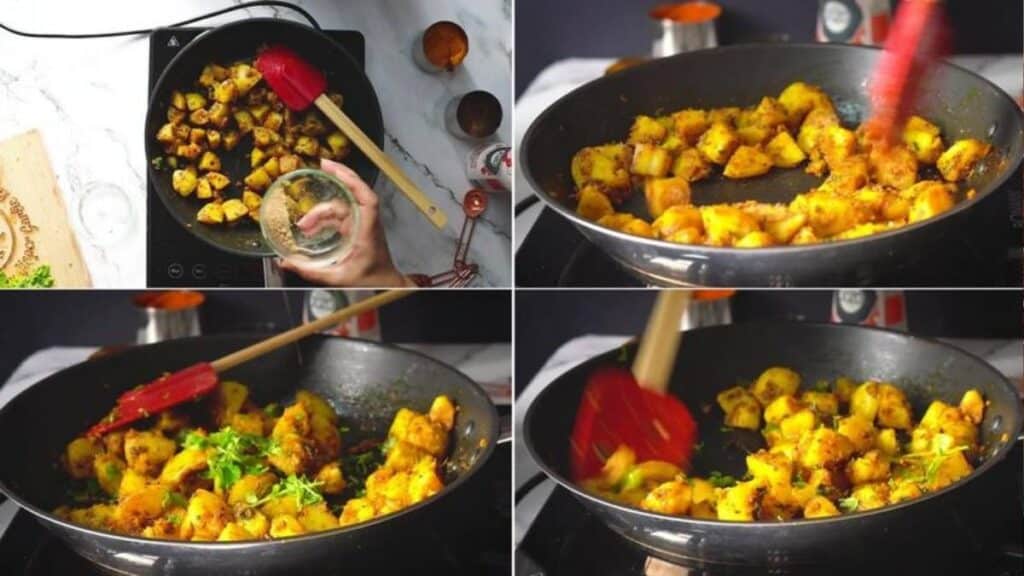
Let the potatoes roast on medium-high heat for 8 to 10 minutes, tossing every 2 to 3 minutes. You’re not stirring continuously—you’re letting them sit in contact with the hot pan long enough to develop golden edges, then tossing to expose new surfaces.
If you want extra crispness, add another 2 minutes of roasting at this stage. According to kitchen testing, each additional 2 minutes of roasting improves crispness measurably.
Time: 8-10 minutes
Step 6: Season and Finish
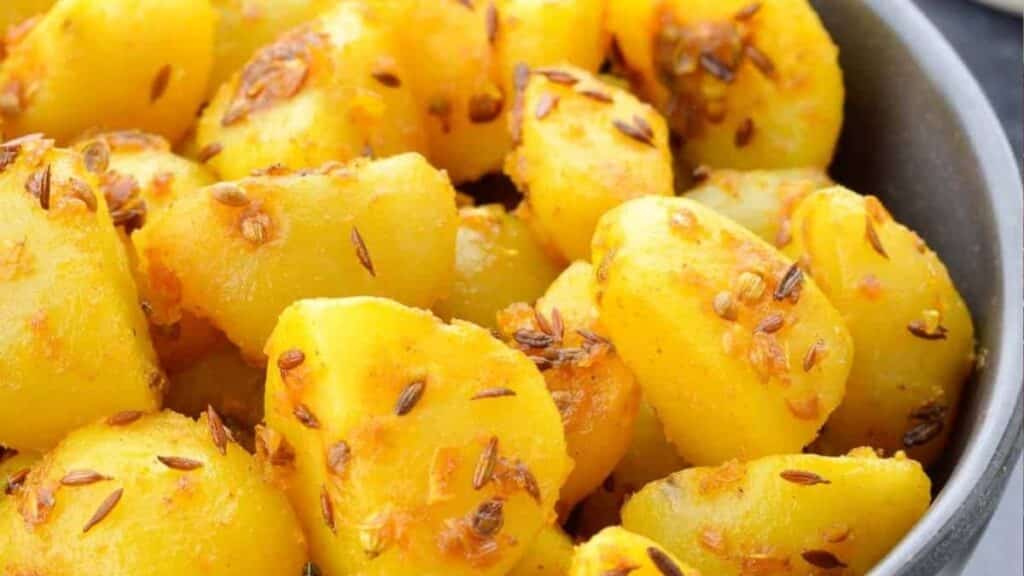
Turn off the heat. Add sendha namak to taste and ½ teaspoon of amchur (dry mango powder). Add the amchur at the end—not during cooking—to prevent it from turning bitter under prolonged heat. Toss everything together.
Garnish with fresh chopped coriander and serve immediately.
Time: 1 minute
Total Time: About 20 Minutes
CHECK MORE ON: Singhare Ka Halwa Recipe
Serving Suggestions
| Serve With | Why It Works |
|---|---|
| Vrat ke chawal (samak rice) | Classic Navratri pairing; dry sabzi with fluffy rice |
| Kuttu ki puri | Crispy-on-crispy; contrasting textures |
| Plain curd or raita | Cooling contrast to the warm, spiced potatoes |
| Dahi aloo | Serve together for complete potato thali with textural contrast |
| Dal (non-fasting) | Classic everyday pairing |
| Bajra or missi roti (non-fasting) | Traditional Rajasthani dhaba combination |
The beauty of aloo jeera is its flexibility. During Navratri, it sits comfortably alongside samak rice and lauki ki sabji on the fasting thali. For everyday meals, it pairs with dal and roti or becomes the quick side dish that rescues a weeknight dinner when you haven’t had time to cook something elaborate. And packed into a lunchbox with some rice, it’s one of those dishes that somehow tastes even better at room temperature than it does hot from the pan.
Storage and Make-Ahead Tips
| Storage Method | Duration | Notes |
|---|---|---|
| Room temperature (covered) | Up to 6 hours | Holds texture well; ideal for tiffin |
| Refrigerated (airtight) | Up to 2 days | Re-crisp before serving |
| Re-crisping method | 2-3 minutes on tawa | Small splash of ghee; medium-high heat |
| Boiled cubed potatoes (refrigerated) | 1 day | Roast fresh for best texture |
One of aloo jeera’s practical advantages is how well it travels and stores. Unlike gravy-based dishes that become watery or dahi-based curries that change texture, aloo jeera holds its character remarkably well. For tiffin boxes, it’s actually ideal—the dry texture means no leaking, and the cumin flavor deepens slightly as it sits, making it arguably more delicious at lunchtime than it was at breakfast.
For reheating, the best method is a quick 2 to 3 minute toss in a hot tawa with a tiny splash of ghee. This re-crisps the edges and revives the aroma without making it greasy. Avoid the microwave if you can—it steams the potatoes and undoes all your careful roasting work.
Why This Recipe Still Matters
There’s a reason aloo jeera shows up in Rajasthani dhabas and Delhi school tiffins and Navratri fasting thalis with equal comfort. It’s one of those recipes that understands something essential about Indian home cooking: that restraint, when applied with precision, produces more satisfaction than abundance.
This dish has two main ingredients. Two. And it asks you to do almost nothing with them except apply the right technique at the right temperature for the right amount of time. In a culinary world increasingly dominated by long ingredient lists and complex processes, aloo jeera is a quiet argument for simplicity done well.
When you make aloo jeera properly—when you dry those potatoes completely, when you let that cumin bloom until it’s fragrant and slightly dark, when you resist the urge to cover the pan even when the potatoes splutter—you’re practicing something that most experienced cooks understand intuitively: that technique matters more than ingredients. That a humble potato and a spoon of cumin, treated with attention and respect, can become something you’d choose over a far more elaborate dish.
Why does my aloo jeera always turn out soft and soggy instead of crispy?
Almost certainly one of three things: the potatoes weren’t dry enough before roasting, the heat was too low, or the pan was covered during cooking.
Can I use raw potatoes instead of boiling them first?
No—not for this recipe. Raw potatoes would need much longer cooking time to become tender, and that extended time over high heat would burn the cumin and spices
What type of potatoes work best for aloo jeera?
Waxy varieties are preferred over starchy ones. Waxy potatoes hold their shape during roasting and give you clean, defined cubes with golden edges.
